


2013 GT Hood Vent Cold Air Intake Water Test

Thread Starter
Bullitt Member

Joined: August 27, 2012
Posts: 275
Likes: 0
From: VA
 2013 GT Hood Vent Cold Air Intake Water Test
Did a worst case scenario test of the hood vents and whether they allow much water ot get on the filter of a cai. Again this is worst case scenario though, simulating if you were to be stopped in heavy rain with wind blowing rain in the vents somewhat.
Should be fine with a little water though, takes a good amount of water to hydrolock an engine. With the filter there and water able to drain out from around it, there shouldn't be issues with it getting submerged in water and causing issues. Interesting results though.

Bullitt Member
Joined: September 8, 2012
Posts: 233
Likes: 0
From: Toronto
Hey w8tlifter, great video. I was surprised just how much water does get in. Like you said though your test was probably a little more extreme than you would typically see.
You have created a great set of videos. Very helpful thanks
You have created a great set of videos. Very helpful thanks
Thread Starter
Bullitt Member
Joined: August 27, 2012
Posts: 275
Likes: 0
From: VA
thanks I appreciate it!
I'll probably be getting this http://www.autoanything.com/air-filt...A2582A0A0.aspx in black to help repel any water.
I'll probably be getting this http://www.autoanything.com/air-filt...A2582A0A0.aspx in black to help repel any water.

Mach 1 Member
Joined: June 16, 2007
Posts: 621
Likes: 12
From: Hagerstown, MD
first, i think this was a dumb move by ford, not taking into consideration where the water goes from the vent. its a cool idea for the vents in the hood.
my suggestion would be: 1. either dont drive it at all in the rain or 2. if you suspect rain then cover that particular vent with either blue painters tape or roadwrap. both will not hurt the paint and will keep the water out.
since i do not have a 13 (i have a 12 without vents) i would wonder what the affect would be with completely sealing off the openings in the vents, so they are "dummy" vents? since its the same engine from the 12 and we dont have vents then the changes should be minimal correct?
my suggestion would be: 1. either dont drive it at all in the rain or 2. if you suspect rain then cover that particular vent with either blue painters tape or roadwrap. both will not hurt the paint and will keep the water out.
since i do not have a 13 (i have a 12 without vents) i would wonder what the affect would be with completely sealing off the openings in the vents, so they are "dummy" vents? since its the same engine from the 12 and we dont have vents then the changes should be minimal correct?

Member
Joined: January 1, 2012
Posts: 42
Likes: 0
From: Ct.
first, i think this was a dumb move by ford, not taking into consideration where the water goes from the vent. its a cool idea for the vents in the hood.
my suggestion would be: 1. either dont drive it at all in the rain or 2. if you suspect rain then cover that particular vent with either blue painters tape or roadwrap. both will not hurt the paint and will keep the water out.
since i do not have a 13 (i have a 12 without vents) i would wonder what the affect would be with completely sealing off the openings in the vents, so they are "dummy" vents? since its the same engine from the 12 and we dont have vents then the changes should be minimal correct?
my suggestion would be: 1. either dont drive it at all in the rain or 2. if you suspect rain then cover that particular vent with either blue painters tape or roadwrap. both will not hurt the paint and will keep the water out.
since i do not have a 13 (i have a 12 without vents) i would wonder what the affect would be with completely sealing off the openings in the vents, so they are "dummy" vents? since its the same engine from the 12 and we dont have vents then the changes should be minimal correct?

Member
Joined: June 27, 2011
Posts: 28
Likes: 0
From: Fayetteville, NC
Um, I may be missing something here, but the factory cold air intake shields the filter for just this reason, among others. Aftermarket cai leave the filter exposed, and from what i've read in others doing testing of the aftermarket intakes, they make little if any difference in power. Am I wrong?
Mach 1 Member
Joined: August 3, 2011
Posts: 700
Likes: 4
From: East Haven, Connecticut
Um, I may be missing something here, but the factory cold air intake shields the filter for just this reason, among others. Aftermarket cai leave the filter exposed, and from what i've read in others doing testing of the aftermarket intakes, they make little if any difference in power. Am I wrong?


Former Vendor
Joined: February 15, 2012
Posts: 602
Likes: 1
OP, thanks for posting. We have done testing on our own 2013s through various conditions (normal driving, stop lights, etc. through Florida rainstorms) with no issues. We have done parked water intrusion tests where we sprayed the vents and we didn't see anywhere near the water intrusion that you have shown in your video, and I suspect it's due to the angle that you were spraying the water and the pressure. As such, it's very unlikely to have that much water intrusion driving in a typical rainstorm, probably the only time you would maybe see that would be if you were driving in a hurricane or something. 
Yes.
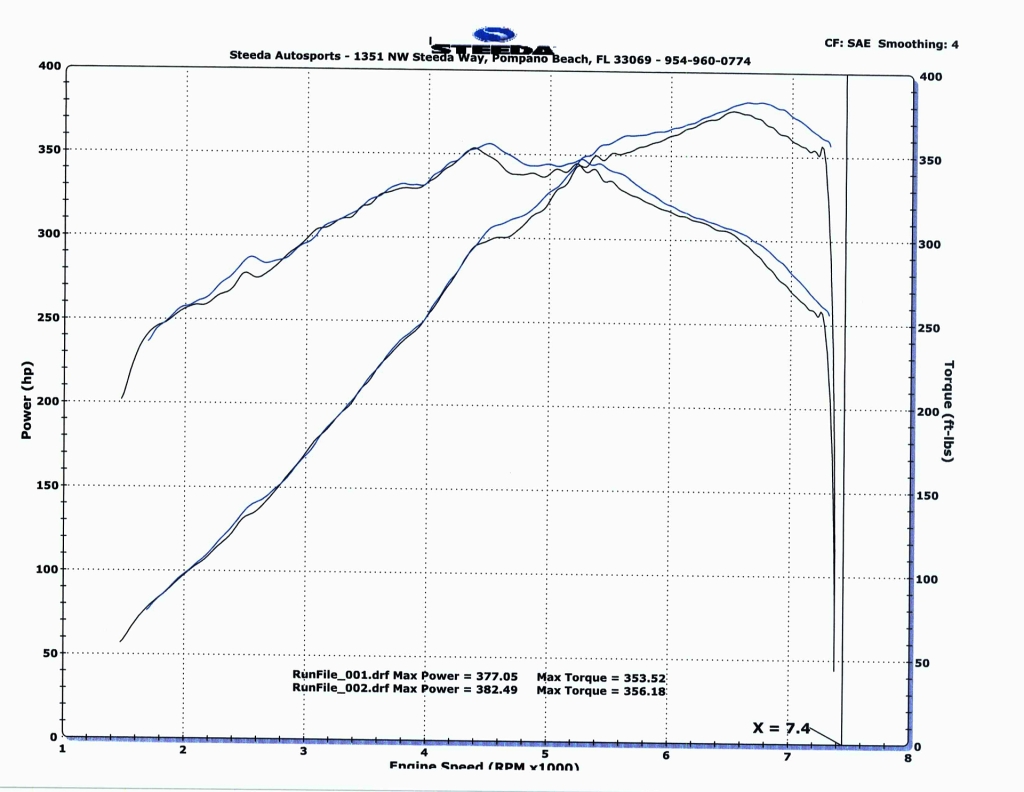
I have attached a dyno sheet that was a test we did about a year and a half ago of the stock airbox vs the cold air.
On this test the car was loaded with a basic tune with no cam timing changes just so we could have a higher rev limiter that way we could rev the engine to the same RPM with both intakes without running into a limiter. Ignition timing was the same for both tunes.
The results show a “peak” gain of only 5 horsepower, but there is a lot more there if you read the dyno sheet. Gains started at about 4,500, with gains of 6 to 9 horsepower between 4,500 and 5,000. Between 5,300 and 6,100 gains were 7 to 10 horsepower. And between 6,700 and 7,200 the gains were an impressive 12 to 15 horsepower. So you can see measurable gains from a cold air intake.
I have attached a dyno sheet that was a test we did about a year and a half ago of the stock airbox vs the cold air.
On this test the car was loaded with a basic tune with no cam timing changes just so we could have a higher rev limiter that way we could rev the engine to the same RPM with both intakes without running into a limiter. Ignition timing was the same for both tunes.
The results show a “peak” gain of only 5 horsepower, but there is a lot more there if you read the dyno sheet. Gains started at about 4,500, with gains of 6 to 9 horsepower between 4,500 and 5,000. Between 5,300 and 6,100 gains were 7 to 10 horsepower. And between 6,700 and 7,200 the gains were an impressive 12 to 15 horsepower. So you can see measurable gains from a cold air intake.

Legacy TMS Member
Joined: July 28, 2004
Posts: 848
Likes: 0
We at C&L have accepted this as an issue from day 1 and even have a customer with a different NAME brand air intake that hydro locked his engine and had to replace the throttle body, intake manifold and one head NOT under warranty.
Our 2013 GT kits come with the proper shielding to prevent this from happening to you.
On a small side note, in the video you can see how wet that shop towel got, especially when it was rung out. When the water hits the filter it will do the same and soak it up like a sponge, then allow it through.
As for Water/Meth Injection you are correct it is injected into the engine, but with a Metered amount, kind like nitrous, at specific times. I've tuned and actually designed water injection kits for the X-charger V6 supercharger system for 05-10 mustangs. One thing I found was that too much water would hurt performance and even eat the protective coating off the supercharger rotors, this was with a .032 sized Jet with 100-125 psi of water pressure, much smaller then a rain drop. The water burns to help keep the intake charge cooler but too much water puts out the spark kernel and water doesn't compress like air.
Thanks, Doug


Our 2013 GT kits come with the proper shielding to prevent this from happening to you.
On a small side note, in the video you can see how wet that shop towel got, especially when it was rung out. When the water hits the filter it will do the same and soak it up like a sponge, then allow it through.
As for Water/Meth Injection you are correct it is injected into the engine, but with a Metered amount, kind like nitrous, at specific times. I've tuned and actually designed water injection kits for the X-charger V6 supercharger system for 05-10 mustangs. One thing I found was that too much water would hurt performance and even eat the protective coating off the supercharger rotors, this was with a .032 sized Jet with 100-125 psi of water pressure, much smaller then a rain drop. The water burns to help keep the intake charge cooler but too much water puts out the spark kernel and water doesn't compress like air.
Thanks, Doug
Last edited by Doug@C&L; Oct 30, 2012 at 09:53 AM.
Thread Starter
Bullitt Member
Joined: August 27, 2012
Posts: 275
Likes: 0
From: VA
OP, thanks for posting. We have done testing on our own 2013s through various conditions (normal driving, stop lights, etc. through Florida rainstorms) with no issues. We have done parked water intrusion tests where we sprayed the vents and we didn't see anywhere near the water intrusion that you have shown in your video, and I suspect it's due to the angle that you were spraying the water and the pressure. As such, it's very unlikely to have that much water intrusion driving in a typical rainstorm, probably the only time you would maybe see that would be if you were driving in a hurricane or something.
We at C&L have accepted this as an issue from day 1 and even have a customer with a different NAME brand air intake that hydro locked his engine and had to replace the throttle body, intake manifold and one head NOT under warranty.
Our 2013 GT kits come with the proper shielding to prevent this from happening to you.
On a small side note, in the video you can see how wet that shop towel got, especially when it was rung out. When the water hits the filter it will do the same and soak it up like a sponge, then allow it through.
As for Water/Meth Injection you are correct it is injected into the engine, but with a Metered amount, kind like nitrous, at specific times. I've tuned and actually designed water injection kits for the X-charger V6 supercharger system for 05-10 mustangs. One thing I found was that too much water would hurt performance and even eat the protective coating off the supercharger rotors, this was with a .032 sized Jet with 100-125 psi of water pressure, much smaller then a rain drop. The water burns to help keep the intake charge cooler but too much water puts out the spark kernel and water doesn't compress like air.
Thanks, Doug
Our 2013 GT kits come with the proper shielding to prevent this from happening to you.
On a small side note, in the video you can see how wet that shop towel got, especially when it was rung out. When the water hits the filter it will do the same and soak it up like a sponge, then allow it through.
As for Water/Meth Injection you are correct it is injected into the engine, but with a Metered amount, kind like nitrous, at specific times. I've tuned and actually designed water injection kits for the X-charger V6 supercharger system for 05-10 mustangs. One thing I found was that too much water would hurt performance and even eat the protective coating off the supercharger rotors, this was with a .032 sized Jet with 100-125 psi of water pressure, much smaller then a rain drop. The water burns to help keep the intake charge cooler but too much water puts out the spark kernel and water doesn't compress like air.
Thanks, Doug

Banned
Joined: October 30, 2012
Posts: 5
Likes: 0
We at C&L have accepted this as an issue from day 1 and even have a customer with a different NAME brand air intake that hydro locked his engine and had to replace the throttle body, intake manifold and one head NOT under warranty.
Our 2013 GT kits come with the proper shielding to prevent this from happening to you.
On a small side note, in the video you can see how wet that shop towel got, especially when it was rung out. When the water hits the filter it will do the same and soak it up like a sponge, then allow it through.
As for Water/Meth Injection you are correct it is injected into the engine, but with a Metered amount, kind like nitrous, at specific times. I've tuned and actually designed water injection kits for the X-charger V6 supercharger system for 05-10 mustangs. One thing I found was that too much water would hurt performance and even eat the protective coating off the supercharger rotors, this was with a .032 sized Jet with 100-125 psi of water pressure, much smaller then a rain drop. The water burns to help keep the intake charge cooler but too much water puts out the spark kernel and water doesn't compress like air.
Thanks, Doug
Our 2013 GT kits come with the proper shielding to prevent this from happening to you.
On a small side note, in the video you can see how wet that shop towel got, especially when it was rung out. When the water hits the filter it will do the same and soak it up like a sponge, then allow it through.
As for Water/Meth Injection you are correct it is injected into the engine, but with a Metered amount, kind like nitrous, at specific times. I've tuned and actually designed water injection kits for the X-charger V6 supercharger system for 05-10 mustangs. One thing I found was that too much water would hurt performance and even eat the protective coating off the supercharger rotors, this was with a .032 sized Jet with 100-125 psi of water pressure, much smaller then a rain drop. The water burns to help keep the intake charge cooler but too much water puts out the spark kernel and water doesn't compress like air.
Thanks, Doug

Thread
Thread Starter
Forum
Replies
Last Post
awoychosky123
'10-14 Exterior Modifications
3
Aug 18, 2015 08:30 AM
tj@steeda
Ecoboost
1
Jul 25, 2015 06:32 PM