


Cutting Rear Springs???


Cobra Member

Joined: August 16, 2005
Posts: 1,079
Likes: 0
From: Central Coast, CA
I would be very interested to know how they "aligned" the rear suspension. 
There are no factory alignment adjustments (or specs) in the rear. No camber, no caster, no thrust angle, no toe, no tracking, not even pinion angle. What did they change and how????
4 wheel alignments are for cars with independent rear suspensions that have adjusters....or maybe I've missed something????
There are no factory alignment adjustments (or specs) in the rear. No camber, no caster, no thrust angle, no toe, no tracking, not even pinion angle. What did they change and how????
4 wheel alignments are for cars with independent rear suspensions that have adjusters....or maybe I've missed something????
Given the fact there are manufacturing tolerances, precise measurement of the rear will reveal very very slight toe, camber and o/a axle alignment (steering) errors to the chassis longitudinal axis. As long as they are small and don't require drastic intervention, the alignment shop will compensate for the rear errors in the front adjustments (unless you have fully independent AND adjustable front and rear suspension (like maybe a GT40 does).

Bullitt Member
Joined: October 13, 2004
Posts: 437
Likes: 1
Did they install camber and caster adjusters up front? Because other than toe there are no factory adjusters there either. (other than normal tolerances)
I got the camber, pinon, and forward control arms and everything set to better than factory tolerances front and rear.
Really, I'm curious what all they did. If they had to grind the front strut holes and install adjusters, it would be good to know.

Team Mustang Source
Joined: April 22, 2004
Posts: 468
Likes: 0
Okay, now this is getting funny. First off, I did not pay $500 to get some one to adjust the panhard, I am not a Dumb@@@!!!! It really irks me how so many people on the boards think they are the only ones with common sense....

I lost the final spec sheet so I was reluctant to make a guess, but if memory serves, it took about 4 hours on the rack at $90/hr (dealer=
 ) required some cutting to notch the forward control arms, do front camber and caster adjustments, plus the rear adjustments, and when it was all done my sheet didn't read "within" tolerances, it read like 0.1° all around. I'd say to anyone lowering their car you should be aware that it isn't just pop the springs and go, you pretty much screw up the front end alignment when you detach the strut tower from the wheel.
 So in conclusion, for all who have a close friend or brother in law who did the whole set up for them for two chickens and a case of PBR

I was not as lucky.
-Darth
Cobra Member
Joined: August 16, 2005
Posts: 1,079
Likes: 0
From: Central Coast, CA
Sorry Darth, but some of us are not clairvoyant.
Well your last post gives a better picture of what you got into after you lowered your car. How much coil cutting did you actually do? Not trying to rub it in, but I still think they got into your shorts. They could have given you more options like offer the concentric bolt kit for camber adjustment or send you back home to elongate the strut mounting holes yourself ... or maybe they did and you decided you were tired of fooling with it or didn't have the time.
They really had to notch the front control arms or were you referring to elongating the holes in the strut where it attaches to the front hubs (for more camber adjustability)?
Well at least you got it running down the road straight now.
Well your last post gives a better picture of what you got into after you lowered your car. How much coil cutting did you actually do? Not trying to rub it in, but I still think they got into your shorts. They could have given you more options like offer the concentric bolt kit for camber adjustment or send you back home to elongate the strut mounting holes yourself ... or maybe they did and you decided you were tired of fooling with it or didn't have the time.
They really had to notch the front control arms or were you referring to elongating the holes in the strut where it attaches to the front hubs (for more camber adjustability)?
Well at least you got it running down the road straight now.

Team Mustang Source
Joined: September 3, 2004
Posts: 840
Likes: 0
From: Beautiful New Hampshire!!!
Darth, what are you calling the "forward control arms" and what did they notch? Just trying to see in my head and on my car, what all you're talking about. I work at the factory building these things and want to know what everyone is going thru so I can avoid all of the mistakes that I can!! Any time that you change the tires, you should at least have the alignment checked, and if you do any frontend work on a rwd car, you should do have it re-aligned too. But, unless you have adjustable lca's, uca's, and/or panhard bar, there is very little you can do ON THE REAR. Still wouldn't hurt to have it all checked out anyways and re-aligned if needed. When I do lower the car all of the way around, I WILL get it aligned b/c I'm hoping to do some auto-x or open-track stuff along with drag race my stang, so it will need a good set-up under it. Right now, I'm just driving it, and trying to figure out what I need to get it to really hook up at the track in the LEAST expensive way!!!

Well, even Darth agrees that the Dealer shop rate was a bit over the top, no matter what kind of alignment they did.
After installing my Steeda Ultralites, I took it to an alignment specialist and had it dialed in for around $45.
After installing my Steeda Ultralites, I took it to an alignment specialist and had it dialed in for around $45.
Team Mustang Source
Joined: September 3, 2004
Posts: 840
Likes: 0
From: Beautiful New Hampshire!!!
Yea, Bill, I'm gonna take the wife's excursion in to the local dealer for an alignment to just check out their equipment and tech's, plus its still in warranty!! Even if i had to have everything adjusted on my stang, I don't believe i'd pay all that much, unless they were installing it all at the same time!!!
Cobra Member
Joined: May 16, 2006
Posts: 1,322
Likes: 0
From: NV
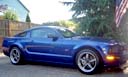
I bought some stock rear springs from 94Tbird and cut one coil off the top of each. I did the math and by cutting one coil off a stock GT coupe rear spring, you get approximately a 158 lb/inch spring rate vs 142.2 for the stock.
I installed the cut springs and have ZERO problems -- no clunking, no popping, no banging. The spring seats just fine in the top seat with one coil cut off the top. I can feel the chassis touching the bumpstops in the rear if I go over a tall speed bump faster than I should (but I'd have that with any aftermarket lowering spring too), though I feel no difference in ride or handling really. It lowered the rear about 3/4 inch and leveled out the car.
I spent $40 dollars on a set of stock springs so I could go back to stock if I ever wanted to. That sure beats ~$200 buying aftermarket rear springs.
I'd say go ahead and cut those springs unless you are a hard core track racer and have to have really high rate springs or you just have to have aftermarket springs so you can brag about having Company XXX's springs as a "mod" on your car.
I installed the cut springs and have ZERO problems -- no clunking, no popping, no banging. The spring seats just fine in the top seat with one coil cut off the top. I can feel the chassis touching the bumpstops in the rear if I go over a tall speed bump faster than I should (but I'd have that with any aftermarket lowering spring too), though I feel no difference in ride or handling really. It lowered the rear about 3/4 inch and leveled out the car.
I spent $40 dollars on a set of stock springs so I could go back to stock if I ever wanted to. That sure beats ~$200 buying aftermarket rear springs.
I'd say go ahead and cut those springs unless you are a hard core track racer and have to have really high rate springs or you just have to have aftermarket springs so you can brag about having Company XXX's springs as a "mod" on your car.
Bullitt Member
Joined: October 13, 2004
Posts: 437
Likes: 1
Bullitt Member
Joined: October 13, 2004
Posts: 437
Likes: 1
If you used the information here or something similar, be sure to remember that while N = number of coils, it's only active coils. The parts of the rear spring coils that sit flat on the perches are not active coils.
I would be surprised if cutting the flat off does much more than just shorten the free length of the spring.
I would be surprised if cutting the flat off does much more than just shorten the free length of the spring.

Although cutting the stock springs work, they were not engineered nor designed to have a coil cut-off. Lowering springs are engineered specifically to give a lower ride height at a calculated spring rate.
LBJay- Don't waste your breath trying to convince the 'cutters'. Some prefer to do things backwood (not that it's a bad thing for some...).
Cobra Member
Joined: August 16, 2005
Posts: 1,079
Likes: 0
From: Central Coast, CA
If you used the information here or something similar, be sure to remember that while N = number of coils, it's only active coils. The parts of the rear spring coils that sit flat on the perches are not active coils.
I would be surprised if cutting the flat off does much more than just shorten the free length of the spring.
I would be surprised if cutting the flat off does much more than just shorten the free length of the spring.
You are right, however even the active coil at the cut will flatten up to half a turn or more once its loaded, so the number of active coils remaining will still be less. But like TacoBill indicated, some of these guys don't care that much about the technical aspects or engineering or figure what they don't know is bliss. They just want a low (smooth [LOL]) rider.
Cobra Member
Joined: May 16, 2006
Posts: 1,322
Likes: 0
From: NV
LBJay
You are right, however even the active coil at the cut will flatten up to half a turn or more once its loaded, so the number of active coils remaining will still be less. But like TacoBill indicated, some of these guys don't care that much about the technical aspects or engineering or figure what they don't know is bliss. They just want a low (smooth [LOL]) rider.
You are right, however even the active coil at the cut will flatten up to half a turn or more once its loaded, so the number of active coils remaining will still be less. But like TacoBill indicated, some of these guys don't care that much about the technical aspects or engineering or figure what they don't know is bliss. They just want a low (smooth [LOL]) rider.
 I learned a lot more about how and why coil springs work and the formulas for calculating the effects of my modifications on the springs than if I had just opened my wallet and bought the Supa Dupa Tuner Ultra Sport Springs I saw advertised in a magazine and had a shop install them for me.



Bullitt Member
Joined: October 13, 2004
Posts: 437
Likes: 1
Nope, an active coil is an active coil. if it is being compressed, it is exerting force. All measurements for the calculation are for the spring at it's free length.
Cobra Member
Joined: August 16, 2005
Posts: 1,079
Likes: 0
From: Central Coast, CA
You should also notice that these springs for these cars are progressive rate. We have variable coil diameters at each end and we have variable coil spacing along the length of the coil. Some springs even have tapered wire. The the coils with smaller spacing and gaps go into coil bind before the others with larger gaps, thus progressively rising the spring rate because the coils that are touching each other are no longer active.
If you take any coil spring and completely coil bind it, the spring goes to near infinite rate because there are no active coils left to spring on (i.e. it becomes rigid and there is no deflection).
Free length rate is different than installed rate, the latter which is more important for evaluation or comparison. In the installed condition some portion of the free length coils go into coil bind.
Team Mustang Source
Joined: September 3, 2004
Posts: 840
Likes: 0
From: Beautiful New Hampshire!!!
Thank you, RadBOSS, for the clarification!! I'm too backwoods to get into all of the technical aspects of everything, but I only cut my springs so I could say that I did it, plus the car looks soo much better leveled out, and it was a free mod (i.e. one that I could afford!!). I'm still researching the companies offering aftermarket springs, and I will go with the one that offers me the best package for the money. I need more than a lowering spring, one thats more performance-oriented so I can use the car for more things, right now its just my daily driver, with occasional dragstrip action. So, I'm leaning towards the BMR springs, H & R's, or Steeda's. Eibach's and Roush are also on my list so you can see my dilemma. I want to drag race, auto-x, and maybe the odd open-track or driving school along with the daily grind, so I need the whole package to work together. I also plan to install these all myself, along with a simple alignment (just to get it to the shop), and pretty mush anything else that I can get for my car.
Cobra Member
Joined: August 16, 2005
Posts: 1,079
Likes: 0
From: Central Coast, CA
Thank you, RadBOSS, for the clarification!! I'm too backwoods to get into all of the technical aspects of everything, but I only cut my springs so I could say that I did it, plus the car looks soo much better leveled out, and it was a free mod (i.e. one that I could afford!!). I'm still researching the companies offering aftermarket springs, and I will go with the one that offers me the best package for the money. I need more than a lowering spring, one thats more performance-oriented so I can use the car for more things, right now its just my daily driver, with occasional dragstrip action. So, I'm leaning towards the BMR springs, H & R's, or Steeda's. Eibach's and Roush are also on my list so you can see my dilemma. I want to drag race, auto-x, and maybe the odd open-track or driving school along with the daily grind, so I need the whole package to work together. I also plan to install these all myself, along with a simple alignment (just to get it to the shop), and pretty mush anything else that I can get for my car.
With the lowering, consider the ball joint drop kit offered by Steeda ... this corrects the change in front roll center, and don't forget the rear LCA and UCA mount relocation brackets (BMR)
Picking the right springs can be bewildering. Some may be more similar to each other than to others. Steeda has a good track record, so you might start there. If your wallet can afford it, don't rule out KW (http://www.kw-suspension.com/en/index.php) for the ultimate in adjustability. Very cool and pratical for the kinda of variability you want.
So where is 69boss in all this talk. He is the one that started all this trouble ...