


Removing resonators



GT Member

Joined: March 20, 2014
Posts: 119
Likes: 1
From: Stockton, CA
Back pressure is a myth folks, like bent valves from running open headers. It is strange the number of things I see repeated as gospel the longer I am in the car scene...
Here is some research and common sense for you:
Here is some research and common sense for you:
Backpressure: The myth and why it's wrong.
I. Introduction
One of the most misunderstood concepts in exhaust theory is backpressure. People love to talk about backpressure on message boards with no real understanding of what it is and what it's consequences are. I'm sure many of you have heard or read the phrase "Engines need backpressure" when discussing exhaust upgrades. That phrase is in fact completely inaccurate and a wholly misguided notion.
II. Some basic exhaust theory
Your exhaust system is designed to evacuate gases from the combustion chamber quickly and efficently. Exhaust gases are not produced in a smooth stream; exhaust gases originate in pulses. A 4 cylinder motor will have 4 distinct pulses per complete engine cycle, a 6 cylinder has 6 pules and so on. The more pulses that are produced, the more continuous the exhaust flow. Backpressure can be loosely defined as the resistance to positive flow - in this case, the resistance to positive flow of the exhaust stream.
III. Backpressure and velocity
Some people operate under the misguided notion that wider pipes are more effective at clearing the combustion chamber than narrower pipes. It's not hard to see how this misconception is appealing - wider pipes have the capability to flow more than narrower pipes. So if they have the ability to flow more, why isn't "wider is better" a good rule of thumb for exhaust upgrading? In a word - VELOCITY. I'm sure that all of you have at one time used a garden hose w/o a spray nozzle on it. If you let the water just run unrestricted out of the house it flows at a rather slow rate. However, if you take your finger and cover part of the opening, the water will flow out at a much much faster rate.
The astute exhaust designer knows that you must balance flow capacity with velocity. You want the exhaust gases to exit the chamber and speed along at the highest velocity possible - you want a FAST exhaust stream. If you have two exhaust pulses of equal volume, one in a 2" pipe and one in a 3" pipe, the pulse in the 2" pipe will be traveling considerably FASTER than the pulse in the 3" pipe. While it is true that the narrower the pipe, the higher the velocity of the exiting gases, you want make sure the pipe is wide enough so that there is as little backpressure as possible while maintaining suitable exhaust gas velocity. Backpressure in it's most extreme form can lead to reversion of the exhaust stream - that is to say the exhaust flows backwards, which is not good. The trick is to have a pipe that that is as narrow as possible while having as close to zero backpressure as possible at the RPM range you want your power band to be located at. Exhaust pipe diameters are best suited to a particular RPM range. A smaller pipe diameter will produce higher exhaust velocities at a lower RPM but create unacceptably high amounts of backpressure at high rpm. Thus if your powerband is located 2-3000 RPM you'd want a narrower pipe than if your powerband is located at 8-9000RPM.
Many engineers try to work around the RPM specific nature of pipe diameters by using setups that are capable of creating a similar effect as a change in pipe diameter on the fly. The most advanced is Ferrari's which consists of two exhaust paths after the header - at low RPM only one path is open to maintain exhaust velocity, but as RPM climbs and exhaust volume increases, the second path is opened to curb backpressure - since there is greater exhaust volume there is no loss in flow velocity. BMW and Nissan use a simpler and less effective method - there is a single exhaust path to the muffler; the muffler has two paths; one path is closed at low RPM but both are open at high RPM.
IV. So how did this myth come to be?
I often wonder how the myth "Engines need backpressure" came to be. Mostly I believe it is a misunderstanding of what is going on with the exhaust stream as pipe diameters change. For instance, someone with a civic decides he's going to uprade his exhaust with a 3" diameter piping. Once it's installed the owner notices that he seems to have lost a good bit of power throughout the powerband. He makes the connections in the following manner: "My wider exhaust eliminated all backpressure but I lost power, therefore the motor must need some backpressure in order to make power." What he did not realize is that he killed off all his flow velocity by using such a ridiculously wide pipe. It would have been possible for him to achieve close to zero backpressure with a much narrower pipe - in that way he would not have lost all his flow velocity.
V. So why is exhaust velocity so important?
The faster an exhaust pulse moves, the better it can scavenge out all of the spent gasses during valve overlap. The guiding principles of exhaust pulse scavenging are a bit beyond the scope of this doc but the general idea is a fast moving pulse creates a low pressure area behind it. This low pressure area acts as a vacuum and draws along the air behind it. A similar example would be a vehicle traveling at a high rate of speed on a dusty road. There is a low pressure area immediately behind the moving vehicle - dust particles get sucked into this low pressure area causing it to collect on the back of the vehicle. This effect is most noticeable on vans and hatchbacks which tend to create large trailing low pressure areas - giving rise to the numerous "wash me please" messages written in the thickly collected dust on the rear door.
Another good read on back pressure:
Destroying a myth.
Some say that "an engine needs backpressure to work correctly." Is this true?
No. It would be more correct to say, "a perfectly stock engine that cannot adjust its fuel delivery needs backpressure to work correctly." This idea is a myth. As with all myths, however, there is a hint of fact with this one. Particularly, some people equate backpressure with torque, and others fear that too little backpressure will lead to valve burning.
The first reason why people say "backpressure is good" is because they believe that increased backpressure by itself will increase torque, particularly with a stock exhaust manifold. Granted, some stock manifolds act somewhat like performance headers at low RPM, but these manifolds will exhibit poor performance at higher RPM. This, however does not automatically lead to the conclusion that backpressure produces more torque. The increase in torque is not due to backpressure, but to the effects of changes in fuel/air mixture, which will be described in more detail below.
The other reason why people say "backpressure is good" is because they hear that cars (or motorcycles) that have had performance exhaust work done to them would then go on to burn exhaust valves. Now, it is true that such valve burning has occurred as a result of the exhaust mods, but it isn't due merely to a lack of backpressure.
The internal combustion engine is a complex, dynamic collection of different systems working together to convert the stored power in gasoline into mechanical energy to push a car down the road. Anytime one of these systems are modified, that mod will also indirectly affect the other systems, as well.
Now, valve burning occurs as a result of a very lean-burning engine. In order to achieve a theoretical optimal combustion, an engine needs 14.7 parts of oxygen by mass to 1 part of gasoline (again, by mass). This is referred to as a stochiometric (chemically correct) mixture, and is commonly referred to as a 14.7:1 mix. If an engine burns with less oxygen present (13:1, 12:1, etc...), it is said to run rich. Conversely, if the engine runs with more oxygen present (16:1, 17:1, etc...), it is said to run lean. Today's engines are designed to run at 14.7:1 for normally cruising, with rich mixtures on acceleration or warm-up, and lean mixtures while decelerating.
Getting back to the discussion, the reason that exhaust valves burn is because the engine is burning lean. Normal engines will tolerate lean burning for a little bit, but not for sustained periods of time. The reason why the engine is burning lean to begin with is that the reduction in backpressure is causing more air to be drawn into the combustion chamber than before. Earlier cars (and motorcycles) with carburetion often could not adjust because of the way that backpressure caused air to flow backwards through the carburetor after the air already got loaded down with fuel, and caused the air to receive a second load of fuel. While a bad design, it was nonetheless used in a lot of vehicles. Once these vehicles received performance mods that reduced backpressure, they no longer had that double-loading effect, and then tended to burn valves because of the resulting over-lean condition. This, incidentally, also provides a basis for the "torque increase" seen if backpressure is maintained. As the fuel/air mixture becomes leaner, the resultant combustion will produce progressively less and less of the force needed to produce torque.
Modern BMWs don't have to worry about the effects described above, because the DME (car's computer) that controls the engine will detect that the engine is burning leaner than before, and will adjust fuel injection to compensate. So, in effect, reducing backpressure really does two good things: The engine can use work otherwise spent pushing exhaust gas out the tailpipe to propel the car forward, and the engine breathes better. Of course, the DME's ability to adjust fuel injection is limited by the physical parameters of the injection system (such as injector maximum flow rate and fuel system pressure), but with exhaust backpressure reduction, these limits won't be reached.
Exhaust Backpressure Study
Replacing the stock production exhaust system with a low-restriction, free-flow one is usually one of the first modifications made to any vehicle in the name of performance. We all know they're louder, but how much performance do they really add? We've all seen supposed dyno tests, usually run by the exhaust manufacturer's themselves on their own dyno, indicating vast power gains, and psychologically, we always equate a healthy exhaust rumble with increased power in the seat of the pants, but how much power are we really gaining? To find out, we're running a simple backpressure study, and our results will be posted here as they come. Admittedly this study is not totally scientific as there are many uncontrolled variables, but it should be sufficient to provide a rough estimate.
It is generally accepted by automotive engineers that for every inch of Hg of backpressure (that's Mercury - inches of Hg is a unit for measuring pressure) approximately 1-2 HP is lost depending on the displacement and efficiency of the engine, the combustion chamber design, etc. Our sources indicated that in the case of the L67 3800SC, 1HP per inch of Hg is reasonable.
1 inch Hg backpressure = 1 HP lost
For reference, we have the following conversions factors:
1 ATM = 14.7 PSI = 76 cm of Hg = 29.921 inches of Hg = 1.013 bar
Our test vehicle is a '97 Buick Regal GS with 3800SC engine transversely mounted. It's exhaust system consists of a cast iron exhaust manifold on the left side of the engine which connects into a tuned tubular header on the right side, both banks connected to a single downpipe into a catalyst. The output of the catalyst runs into a resonator and then into a single muffler; all pipes are 2.25 inch. The exhaust system is very similar in the Pontiac GTP, the differences being that the GTP splits into 2 mufflers after the resonator. Our sources indicate that the GTP system results in approximately 3 in Hg less backpressure than the Regal, hence there is 3 less horsepower loss.
To measure system backpressure, a sample tube was mounted before the catalyst into the downtube
A flexible hose is run from the sample tube and attached to a pressure
gauge inside the car for monitoring.
We first ran the test with the complete full factory exhaust, and next dropped the entire system from the catalyst back.
The final test was run with the muffler removed. Only the catalyst, resonator, and the majority of 2.25 tubing up to the muffler remained.
Next we took a look at the restrictive U bend that houses the post O2 sensor. It's function is to protect the O2 sensor from damage by positioning it straight up.
This restrictive U bend is completely removed, and replaced with a straight 3" piece. (Note this 3" piece is not the actual replacement pipe - it's just a scrap piece for the photo.)
This U bent tube is replaced by this straight 3" pipe. The O2 sensor is mounted to the side - less protected, but it'll be OK unless you go off-roading as we recently did!
Results & Conclusions
We ran three tests, observing three runs with each configuration and averaging the three. Peak backpressure occurred near the engine RPM redline of 5700-6000 rpm, at a max boost of approximately 7-8 psi. We took all our readings at WOT immediately before the 1-2 shift. Although we performed our tests on a Buick Regal GS, we predict a GTP will have similar results, taking into account the 3 in Hg difference. We realize our tests are not totally scientific, and they were not meant to be. Our goal is to obtain a ballpark estimate which, as the saying goes, is "good enough for government work." [Before you government employees start flaming us - one of our associates worked for the US Army Corps of Engineers for several years, so we know how it is. 8^) ]
1. Full factory exhaust system of catalyst, resonator & muffler: 28-30 in Hg = 28-30HP lost [system is whisper quiet]
2. Only catalyst in place, no resonator or muffler after the cat: 13-14 in Hg = 13-14HP lost, thus approximately 14-17 HP gained over stock full exhaust [system is unbearably loud and shakes the entire car, conversation is impossible]
3. No muffler, just resonator, catalyst & tubing 20 in Hg = 20HP lost, thus approximately 10HP gained over stock full exhaust [system is bearable, but has some bad resonances and drones at particular RPMs.]
4. "U" pipe replaced with straight 3" pipe Testing to be determined.
The catalyst was never removed as we were only interested in achieving an optimal cat-back system. We can see from our results that the muffler is costing approximately 10HP loss while the resonator accounts for a 6HP drop, with everything from catalyst to the engine costing 14-15HP.
Therefore, it's evident that at best, a free-flow system will gain perhaps 10HP - and that's for a noisy system, while one which controls irritating resonances and drones better would probably gain less than that. Therefore, a 5-7HP gain from a cat-back exhaust system is probably in the ballpark for achievable gains.
Will removing the catalyst help? Definitely, but that's illegal for street use and probably more importantly to some folks out there, it sets an OBDII Malf code. Replacing the factory catalyst with a high-flow unit will not result in a significant increase either, as those "high-flow" units outflow a production unit by a couple of inches of Hg at best. In fact, our sources indicate that the catalyst on these cars are actually one of the least restrictive available. With a FWD platform, we're stuck with uneven header lengths due to the transverse mounted engine, limiting one's ability to truly optimize the header design. Therefore, it is probably more fruitful and definitely more cost effective to examine the situation after the catalyst.
The difficulty in designing an effective exhaust system is in minimizing backpressure while achieving a desirable exhaust tone with minimal resonances and drones. It has been suggested that replacing both the resonator and muffler with a single large staight-thru muffler (with dual outlets for the GTP) may be the best solution.
Headers are one of the easiest bolt-on accessories you can use to improve an engine's performance. The goal of headers is to make it easier for the engine to push exhaust gases out of the cylinders.
When you look at the four-stroke cycle in How Car Engines Work, you can see that the engine produces all of its power during the power stroke. The gasoline in the cylinder burns and expands during this stroke, generating power. The other three strokes are necessary evils required to make the power stroke possible. If these three strokes consume power, they are a drain on the engine.
During the exhaust stroke, a good way for an engine to lose power is through back pressure. The exhaust valve opens at the beginning of the exhaust stroke, and then the piston pushes the exhaust gases out of the cylinder. If there is any amount of resistance that the piston has to push against to force the exhaust gases out, power is wasted. Using two exhaust valves rather than one improves the flow by making the hole that the exhaust gases travel through larger.
In a normal engine, once the exhaust gases exit the cylinder they end up in the exhaust manifold. In a four-cylinder or eight-cylinder engine, there are four cylinders using the same manifold. From the manifold, the exhaust gases flow into one pipe toward the catalytic converter and the *muffler. It turns out that the manifold can be an important source of back pressure because exhaust gases from one cylinder build up pressure in the manifold that affects the next cylinder that uses the manifold.
The idea behind an exhaust header is to eliminate the manifold's back pressure. Instead of a common manifold that all of the cylinders share, each cylinder gets its own exhaust pipe. These pipes come together in a larger pipe called the collector. The individual pipes are cut and bent so that each one is the same length as the others. By making them the same length, it guarantees that each cylinder's exhaust gases arrive in the collector spaced out equally so there is no back pressure generated by the cylinders sharing the collector.
Headers are one of the easiest bolt-on accessories you can use to improve an engine's performance. The goal of headers is to make it easier for the engine to push exhaust gases out of the cylinders.
When you look at the four-stroke cycle in How Car Engines Work, you can see that the engine produces all of its power during the power stroke. The gasoline in the cylinder burns and expands during this stroke, generating power. The other three strokes are necessary evils required to make the power stroke possible. If these three strokes consume power, they are a drain on the engine.
During the exhaust stroke, a good way for an engine to lose power is through back pressure. The exhaust valve opens at the beginning of the exhaust stroke, and then the piston pushes the exhaust gases out of the cylinder. If there is any amount of resistance that the piston has to push against to force the exhaust gases out, power is wasted. Using two exhaust valves rather than one improves the flow by making the hole that the exhaust gases travel through larger.
I. Introduction
One of the most misunderstood concepts in exhaust theory is backpressure. People love to talk about backpressure on message boards with no real understanding of what it is and what it's consequences are. I'm sure many of you have heard or read the phrase "Engines need backpressure" when discussing exhaust upgrades. That phrase is in fact completely inaccurate and a wholly misguided notion.
II. Some basic exhaust theory
Your exhaust system is designed to evacuate gases from the combustion chamber quickly and efficently. Exhaust gases are not produced in a smooth stream; exhaust gases originate in pulses. A 4 cylinder motor will have 4 distinct pulses per complete engine cycle, a 6 cylinder has 6 pules and so on. The more pulses that are produced, the more continuous the exhaust flow. Backpressure can be loosely defined as the resistance to positive flow - in this case, the resistance to positive flow of the exhaust stream.
III. Backpressure and velocity
Some people operate under the misguided notion that wider pipes are more effective at clearing the combustion chamber than narrower pipes. It's not hard to see how this misconception is appealing - wider pipes have the capability to flow more than narrower pipes. So if they have the ability to flow more, why isn't "wider is better" a good rule of thumb for exhaust upgrading? In a word - VELOCITY. I'm sure that all of you have at one time used a garden hose w/o a spray nozzle on it. If you let the water just run unrestricted out of the house it flows at a rather slow rate. However, if you take your finger and cover part of the opening, the water will flow out at a much much faster rate.
The astute exhaust designer knows that you must balance flow capacity with velocity. You want the exhaust gases to exit the chamber and speed along at the highest velocity possible - you want a FAST exhaust stream. If you have two exhaust pulses of equal volume, one in a 2" pipe and one in a 3" pipe, the pulse in the 2" pipe will be traveling considerably FASTER than the pulse in the 3" pipe. While it is true that the narrower the pipe, the higher the velocity of the exiting gases, you want make sure the pipe is wide enough so that there is as little backpressure as possible while maintaining suitable exhaust gas velocity. Backpressure in it's most extreme form can lead to reversion of the exhaust stream - that is to say the exhaust flows backwards, which is not good. The trick is to have a pipe that that is as narrow as possible while having as close to zero backpressure as possible at the RPM range you want your power band to be located at. Exhaust pipe diameters are best suited to a particular RPM range. A smaller pipe diameter will produce higher exhaust velocities at a lower RPM but create unacceptably high amounts of backpressure at high rpm. Thus if your powerband is located 2-3000 RPM you'd want a narrower pipe than if your powerband is located at 8-9000RPM.
Many engineers try to work around the RPM specific nature of pipe diameters by using setups that are capable of creating a similar effect as a change in pipe diameter on the fly. The most advanced is Ferrari's which consists of two exhaust paths after the header - at low RPM only one path is open to maintain exhaust velocity, but as RPM climbs and exhaust volume increases, the second path is opened to curb backpressure - since there is greater exhaust volume there is no loss in flow velocity. BMW and Nissan use a simpler and less effective method - there is a single exhaust path to the muffler; the muffler has two paths; one path is closed at low RPM but both are open at high RPM.
IV. So how did this myth come to be?
I often wonder how the myth "Engines need backpressure" came to be. Mostly I believe it is a misunderstanding of what is going on with the exhaust stream as pipe diameters change. For instance, someone with a civic decides he's going to uprade his exhaust with a 3" diameter piping. Once it's installed the owner notices that he seems to have lost a good bit of power throughout the powerband. He makes the connections in the following manner: "My wider exhaust eliminated all backpressure but I lost power, therefore the motor must need some backpressure in order to make power." What he did not realize is that he killed off all his flow velocity by using such a ridiculously wide pipe. It would have been possible for him to achieve close to zero backpressure with a much narrower pipe - in that way he would not have lost all his flow velocity.
V. So why is exhaust velocity so important?
The faster an exhaust pulse moves, the better it can scavenge out all of the spent gasses during valve overlap. The guiding principles of exhaust pulse scavenging are a bit beyond the scope of this doc but the general idea is a fast moving pulse creates a low pressure area behind it. This low pressure area acts as a vacuum and draws along the air behind it. A similar example would be a vehicle traveling at a high rate of speed on a dusty road. There is a low pressure area immediately behind the moving vehicle - dust particles get sucked into this low pressure area causing it to collect on the back of the vehicle. This effect is most noticeable on vans and hatchbacks which tend to create large trailing low pressure areas - giving rise to the numerous "wash me please" messages written in the thickly collected dust on the rear door.
Another good read on back pressure:
Destroying a myth.
Some say that "an engine needs backpressure to work correctly." Is this true?
No. It would be more correct to say, "a perfectly stock engine that cannot adjust its fuel delivery needs backpressure to work correctly." This idea is a myth. As with all myths, however, there is a hint of fact with this one. Particularly, some people equate backpressure with torque, and others fear that too little backpressure will lead to valve burning.
The first reason why people say "backpressure is good" is because they believe that increased backpressure by itself will increase torque, particularly with a stock exhaust manifold. Granted, some stock manifolds act somewhat like performance headers at low RPM, but these manifolds will exhibit poor performance at higher RPM. This, however does not automatically lead to the conclusion that backpressure produces more torque. The increase in torque is not due to backpressure, but to the effects of changes in fuel/air mixture, which will be described in more detail below.
The other reason why people say "backpressure is good" is because they hear that cars (or motorcycles) that have had performance exhaust work done to them would then go on to burn exhaust valves. Now, it is true that such valve burning has occurred as a result of the exhaust mods, but it isn't due merely to a lack of backpressure.
The internal combustion engine is a complex, dynamic collection of different systems working together to convert the stored power in gasoline into mechanical energy to push a car down the road. Anytime one of these systems are modified, that mod will also indirectly affect the other systems, as well.
Now, valve burning occurs as a result of a very lean-burning engine. In order to achieve a theoretical optimal combustion, an engine needs 14.7 parts of oxygen by mass to 1 part of gasoline (again, by mass). This is referred to as a stochiometric (chemically correct) mixture, and is commonly referred to as a 14.7:1 mix. If an engine burns with less oxygen present (13:1, 12:1, etc...), it is said to run rich. Conversely, if the engine runs with more oxygen present (16:1, 17:1, etc...), it is said to run lean. Today's engines are designed to run at 14.7:1 for normally cruising, with rich mixtures on acceleration or warm-up, and lean mixtures while decelerating.
Getting back to the discussion, the reason that exhaust valves burn is because the engine is burning lean. Normal engines will tolerate lean burning for a little bit, but not for sustained periods of time. The reason why the engine is burning lean to begin with is that the reduction in backpressure is causing more air to be drawn into the combustion chamber than before. Earlier cars (and motorcycles) with carburetion often could not adjust because of the way that backpressure caused air to flow backwards through the carburetor after the air already got loaded down with fuel, and caused the air to receive a second load of fuel. While a bad design, it was nonetheless used in a lot of vehicles. Once these vehicles received performance mods that reduced backpressure, they no longer had that double-loading effect, and then tended to burn valves because of the resulting over-lean condition. This, incidentally, also provides a basis for the "torque increase" seen if backpressure is maintained. As the fuel/air mixture becomes leaner, the resultant combustion will produce progressively less and less of the force needed to produce torque.
Modern BMWs don't have to worry about the effects described above, because the DME (car's computer) that controls the engine will detect that the engine is burning leaner than before, and will adjust fuel injection to compensate. So, in effect, reducing backpressure really does two good things: The engine can use work otherwise spent pushing exhaust gas out the tailpipe to propel the car forward, and the engine breathes better. Of course, the DME's ability to adjust fuel injection is limited by the physical parameters of the injection system (such as injector maximum flow rate and fuel system pressure), but with exhaust backpressure reduction, these limits won't be reached.
Exhaust Backpressure Study
Replacing the stock production exhaust system with a low-restriction, free-flow one is usually one of the first modifications made to any vehicle in the name of performance. We all know they're louder, but how much performance do they really add? We've all seen supposed dyno tests, usually run by the exhaust manufacturer's themselves on their own dyno, indicating vast power gains, and psychologically, we always equate a healthy exhaust rumble with increased power in the seat of the pants, but how much power are we really gaining? To find out, we're running a simple backpressure study, and our results will be posted here as they come. Admittedly this study is not totally scientific as there are many uncontrolled variables, but it should be sufficient to provide a rough estimate.
It is generally accepted by automotive engineers that for every inch of Hg of backpressure (that's Mercury - inches of Hg is a unit for measuring pressure) approximately 1-2 HP is lost depending on the displacement and efficiency of the engine, the combustion chamber design, etc. Our sources indicated that in the case of the L67 3800SC, 1HP per inch of Hg is reasonable.
1 inch Hg backpressure = 1 HP lost
For reference, we have the following conversions factors:
1 ATM = 14.7 PSI = 76 cm of Hg = 29.921 inches of Hg = 1.013 bar
Our test vehicle is a '97 Buick Regal GS with 3800SC engine transversely mounted. It's exhaust system consists of a cast iron exhaust manifold on the left side of the engine which connects into a tuned tubular header on the right side, both banks connected to a single downpipe into a catalyst. The output of the catalyst runs into a resonator and then into a single muffler; all pipes are 2.25 inch. The exhaust system is very similar in the Pontiac GTP, the differences being that the GTP splits into 2 mufflers after the resonator. Our sources indicate that the GTP system results in approximately 3 in Hg less backpressure than the Regal, hence there is 3 less horsepower loss.
To measure system backpressure, a sample tube was mounted before the catalyst into the downtube
A flexible hose is run from the sample tube and attached to a pressure
gauge inside the car for monitoring.
We first ran the test with the complete full factory exhaust, and next dropped the entire system from the catalyst back.
The final test was run with the muffler removed. Only the catalyst, resonator, and the majority of 2.25 tubing up to the muffler remained.
Next we took a look at the restrictive U bend that houses the post O2 sensor. It's function is to protect the O2 sensor from damage by positioning it straight up.
This restrictive U bend is completely removed, and replaced with a straight 3" piece. (Note this 3" piece is not the actual replacement pipe - it's just a scrap piece for the photo.)
This U bent tube is replaced by this straight 3" pipe. The O2 sensor is mounted to the side - less protected, but it'll be OK unless you go off-roading as we recently did!
Results & Conclusions
We ran three tests, observing three runs with each configuration and averaging the three. Peak backpressure occurred near the engine RPM redline of 5700-6000 rpm, at a max boost of approximately 7-8 psi. We took all our readings at WOT immediately before the 1-2 shift. Although we performed our tests on a Buick Regal GS, we predict a GTP will have similar results, taking into account the 3 in Hg difference. We realize our tests are not totally scientific, and they were not meant to be. Our goal is to obtain a ballpark estimate which, as the saying goes, is "good enough for government work." [Before you government employees start flaming us - one of our associates worked for the US Army Corps of Engineers for several years, so we know how it is. 8^) ]
1. Full factory exhaust system of catalyst, resonator & muffler: 28-30 in Hg = 28-30HP lost [system is whisper quiet]
2. Only catalyst in place, no resonator or muffler after the cat: 13-14 in Hg = 13-14HP lost, thus approximately 14-17 HP gained over stock full exhaust [system is unbearably loud and shakes the entire car, conversation is impossible]
3. No muffler, just resonator, catalyst & tubing 20 in Hg = 20HP lost, thus approximately 10HP gained over stock full exhaust [system is bearable, but has some bad resonances and drones at particular RPMs.]
4. "U" pipe replaced with straight 3" pipe Testing to be determined.
The catalyst was never removed as we were only interested in achieving an optimal cat-back system. We can see from our results that the muffler is costing approximately 10HP loss while the resonator accounts for a 6HP drop, with everything from catalyst to the engine costing 14-15HP.
Therefore, it's evident that at best, a free-flow system will gain perhaps 10HP - and that's for a noisy system, while one which controls irritating resonances and drones better would probably gain less than that. Therefore, a 5-7HP gain from a cat-back exhaust system is probably in the ballpark for achievable gains.
Will removing the catalyst help? Definitely, but that's illegal for street use and probably more importantly to some folks out there, it sets an OBDII Malf code. Replacing the factory catalyst with a high-flow unit will not result in a significant increase either, as those "high-flow" units outflow a production unit by a couple of inches of Hg at best. In fact, our sources indicate that the catalyst on these cars are actually one of the least restrictive available. With a FWD platform, we're stuck with uneven header lengths due to the transverse mounted engine, limiting one's ability to truly optimize the header design. Therefore, it is probably more fruitful and definitely more cost effective to examine the situation after the catalyst.
The difficulty in designing an effective exhaust system is in minimizing backpressure while achieving a desirable exhaust tone with minimal resonances and drones. It has been suggested that replacing both the resonator and muffler with a single large staight-thru muffler (with dual outlets for the GTP) may be the best solution.
Headers are one of the easiest bolt-on accessories you can use to improve an engine's performance. The goal of headers is to make it easier for the engine to push exhaust gases out of the cylinders.
When you look at the four-stroke cycle in How Car Engines Work, you can see that the engine produces all of its power during the power stroke. The gasoline in the cylinder burns and expands during this stroke, generating power. The other three strokes are necessary evils required to make the power stroke possible. If these three strokes consume power, they are a drain on the engine.
During the exhaust stroke, a good way for an engine to lose power is through back pressure. The exhaust valve opens at the beginning of the exhaust stroke, and then the piston pushes the exhaust gases out of the cylinder. If there is any amount of resistance that the piston has to push against to force the exhaust gases out, power is wasted. Using two exhaust valves rather than one improves the flow by making the hole that the exhaust gases travel through larger.
In a normal engine, once the exhaust gases exit the cylinder they end up in the exhaust manifold. In a four-cylinder or eight-cylinder engine, there are four cylinders using the same manifold. From the manifold, the exhaust gases flow into one pipe toward the catalytic converter and the *muffler. It turns out that the manifold can be an important source of back pressure because exhaust gases from one cylinder build up pressure in the manifold that affects the next cylinder that uses the manifold.
The idea behind an exhaust header is to eliminate the manifold's back pressure. Instead of a common manifold that all of the cylinders share, each cylinder gets its own exhaust pipe. These pipes come together in a larger pipe called the collector. The individual pipes are cut and bent so that each one is the same length as the others. By making them the same length, it guarantees that each cylinder's exhaust gases arrive in the collector spaced out equally so there is no back pressure generated by the cylinders sharing the collector.
Headers are one of the easiest bolt-on accessories you can use to improve an engine's performance. The goal of headers is to make it easier for the engine to push exhaust gases out of the cylinders.
When you look at the four-stroke cycle in How Car Engines Work, you can see that the engine produces all of its power during the power stroke. The gasoline in the cylinder burns and expands during this stroke, generating power. The other three strokes are necessary evils required to make the power stroke possible. If these three strokes consume power, they are a drain on the engine.
During the exhaust stroke, a good way for an engine to lose power is through back pressure. The exhaust valve opens at the beginning of the exhaust stroke, and then the piston pushes the exhaust gases out of the cylinder. If there is any amount of resistance that the piston has to push against to force the exhaust gases out, power is wasted. Using two exhaust valves rather than one improves the flow by making the hole that the exhaust gases travel through larger.



Bullitt Member
Joined: October 3, 2012
Posts: 499
Likes: 0
From: Near Chattanooga, TN
Loved the info on back pressure vs velocity, perhaps people are just using the wrong term?, but Im still confused as to the actual purpose of a resonator. Clearly Ford put them on the mustang for a purpose, removing them defeats that purpose. So it begs the question why are they there and what happens to an engine when they are removed, positive or negative.
If it is purely sound, why didn't the engineers just increase the size or shape of the muffler?
It would be nice if Ford chimed in, but I don't think that will happen.
In any event, thanks for the info and taking the time to explain it.
If it is purely sound, why didn't the engineers just increase the size or shape of the muffler?
It would be nice if Ford chimed in, but I don't think that will happen.
In any event, thanks for the info and taking the time to explain it.
GT Member
Joined: March 20, 2014
Posts: 119
Likes: 1
From: Stockton, CA
My guess would be a form of sound tuning, they were added to fine tweak, or to "tune" the sound of the 5.0 Coyote with the stock exhaust. Incidentally, the GT500 uses the same diameter over the axle pipes, the only real difference is there are no resonators. So if I were to venture a guess they are there to keep the Ti-VCT 5.0 from flag ship car levels, or to change it to sound more like a "Mustang"; not really to lessen the sound, like a re-design or change of the mufflers, but a tuning method to change the exhaust note subtly.


 Particularly the effect of exhaust velocity on the amount of fresh air sucked in.

GT Member
Joined: August 21, 2013
Posts: 113
Likes: 0
From: Indianapolis, Indiana
Great post....I really enjoyed the reading of the velocity and aspects....I have been pricing tuned headers for my six....and when I install them, then I will remove the resonators....oh the sound I will hear then......BIG GRINS.....Thank you again

Mach 1 Member
Joined: April 30, 2014
Posts: 936
Likes: 40
I would think that the resonator acts more like a "deresonator" if that's a real word. You don't want the two exhaust pipes to resonate with each other. So I think the two resonators tune each exhaust slightly differently so that doesn't happen.



I Have No Life
Joined: September 24, 2011
Posts: 10,141
Likes: 172
Yep. Same. GT500 ab's are good sounding, but just too tame/quiet for me. I had them on for a year, then switched to Borla S, then now to Corsa Extreme plus a full x pipe catback. Perfection.

GT Member
Joined: July 28, 2011
Posts: 111
Likes: 0
I have a 14 GT and I installed my GT500 axle backs and had then cut out the resonators the same day. I never had the experience of running them with the resonators installed. Usually resonators are there to tame the exhaust sound a little bit.
What they will do, is cut out the resonators and weld in a piece of straight pipe. OR, should you want to keep the resonators installed, you could get what's called "Over Axle Pipes" and essentially they bypass the resonators.
I like the sound of mine. It's mean. It pop and gurgles when I downshift. It's not overly loud to my ears except on a cold start. But I have had neighbours complain and apparently phone the cops and complain this week, so it must be loud enough to annoy them!
What they will do, is cut out the resonators and weld in a piece of straight pipe. OR, should you want to keep the resonators installed, you could get what's called "Over Axle Pipes" and essentially they bypass the resonators.
I like the sound of mine. It's mean. It pop and gurgles when I downshift. It's not overly loud to my ears except on a cold start. But I have had neighbours complain and apparently phone the cops and complain this week, so it must be loud enough to annoy them!
I will be soon. I got some free Jegs down pipes from a friend who traded in his car. Just need to find the time and motivation to install them.
They are all dented from the factory. Flat on the bottom on one side and flat on the top on the other.
That would be a hard one to determine. When the car sounds better, you're more inclined to drive harder.
I think my car would get better mileage with its Steeda intake and tune than stock, but I have too much fun listening to it. Plus, the GT 500 quad tips sound great. I find myself switching to manual shift just to hear it burble when downshifting.
I think my car would get better mileage with its Steeda intake and tune than stock, but I have too much fun listening to it. Plus, the GT 500 quad tips sound great. I find myself switching to manual shift just to hear it burble when downshifting.
Loved the info on back pressure vs velocity, perhaps people are just using the wrong term?, but Im still confused as to the actual purpose of a resonator. Clearly Ford put them on the mustang for a purpose, removing them defeats that purpose. So it begs the question why are they there and what happens to an engine when they are removed, positive or negative.
If it is purely sound, why didn't the engineers just increase the size or shape of the muffler?
It would be nice if Ford chimed in, but I don't think that will happen.
In any event, thanks for the info and taking the time to explain it.
If it is purely sound, why didn't the engineers just increase the size or shape of the muffler?
It would be nice if Ford chimed in, but I don't think that will happen.
In any event, thanks for the info and taking the time to explain it.
GT Member
Joined: March 20, 2014
Posts: 119
Likes: 1
From: Stockton, CA
If you look at the stock H-pipe it kind of necks down at the bends down to 2.5" IIRC, so most of the gains of a true catback will be in completely better exhaust flow from the cats back...
Last edited by Azrael; Mar 20, 2015 at 09:32 PM.

Mach 1 Member
Joined: December 3, 2012
Posts: 538
Likes: 11
From: SoCal
Not really, most catbacks for our cars include a mid-pipe (usually 3" X or H), OTA pipes (usually 3" and mandrel bent), and axle-backs that will connect to their own OTA (usually slip fit unlike the ball clamp joint of the stock system).
If you look at the stock H-pipe it kind of necks down at the bends down to 2.5" IIRC, so most of the gains of a true catback will be in completely better exhaust flow from the cats back...
GT Member
Joined: March 20, 2014
Posts: 119
Likes: 1
From: Stockton, CA
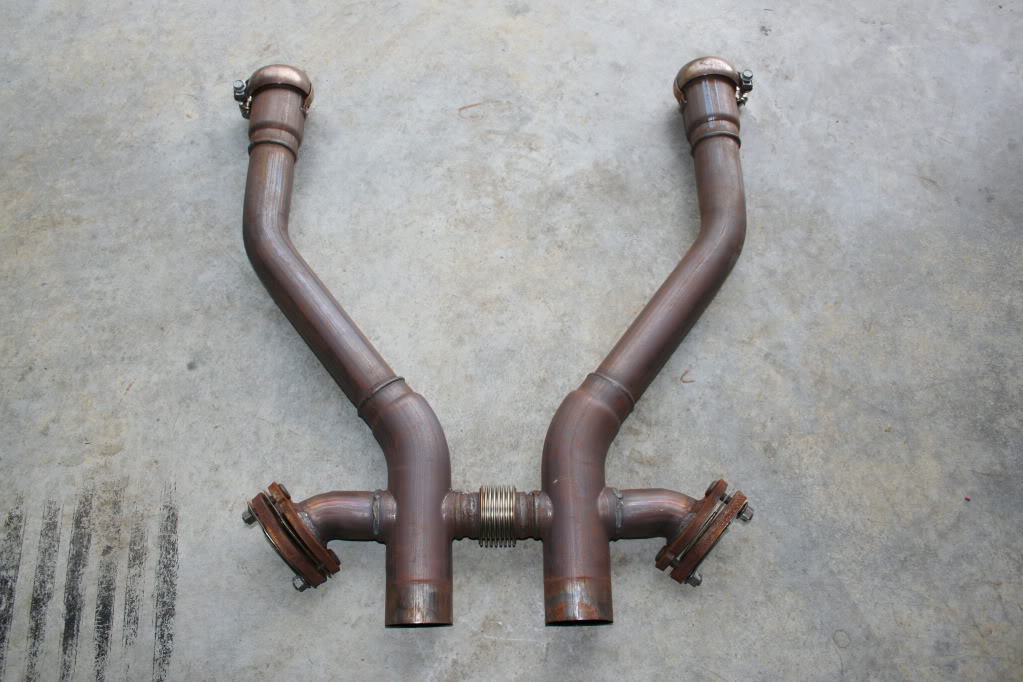
The general idea of a catback is that it works well throughout its replacement of everything from the cats back (hence the name). Generally though resonator-deleted or aftermarket OTA pipes tied in with an H-pipe will basically be the same thing. That is what I have done, MBRP 3" H-Pipe with resonator delete...
Mach 1 Member
Joined: December 3, 2012
Posts: 538
Likes: 11
From: SoCal
Pretty much, is it the stock Boss H-pipe with the side exhaust? IIRC they neck down too, but not sure as I type this; I will have to go find out.
The general idea of a catback is that it works well throughout its replacement of everything from the cats back (hence the name). Generally though resonator-deleted or aftermarket OTA pipes tied in with an H-pipe will basically be the same thing. That is what I have done, MBRP 3" H-Pipe with resonator delete...
All the images I see about Catback systems show straight OTA pipes with Axlebacks attached at the end, so was curious if I ended up creating the custom Catback of my own. Sorta.
I might replace the GT500ab with something else down the road, possibly Corsa Extreme. Love the exhaust sound on Mustangs hehe. Louder!
Mach 1 Member
Joined: December 3, 2012
Posts: 538
Likes: 11
From: SoCal


