


can someone tell me what the corect pinion angle would be?


Thread Starter
Mach 1 Member

Joined: June 17, 2005
Posts: 900
Likes: 0
can someone tell me what the corect pinion angle would be?
ok im tired of shops not knowing how to set the pinion angle, so i am doing it tomorrow at my boy's shop. he has a drive on lift. my car has stock suspension, except for bmr adjustable UCA and LCA. i have the 4" powerhouse driveshaft. what would be the correct net pinion angle? i am going to do it by getting the 2 angles from this diagram, and then adding them. anyone know what it should be? i searched and couldnt find it.
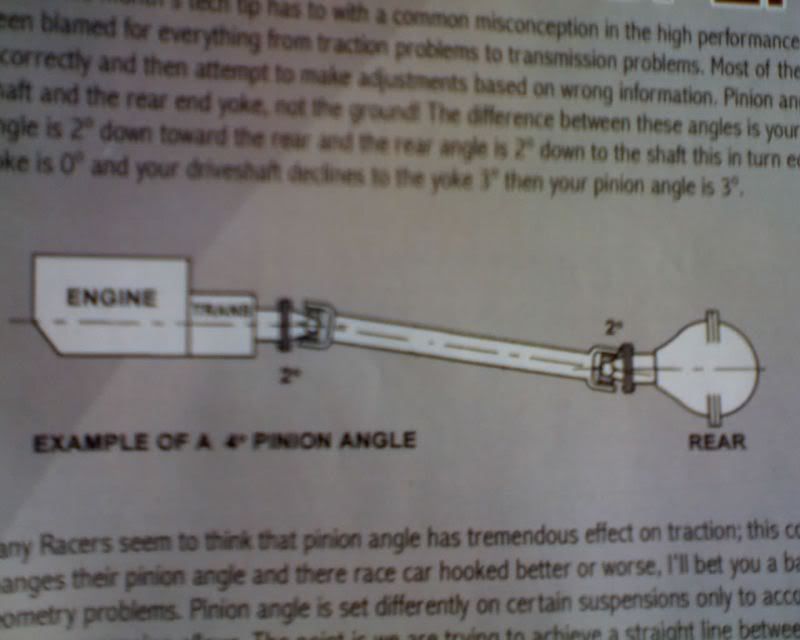

Check this link it's pretty good info from Steeda. I have heard several people go with around negative 3 degrees.
http://www.steeda.com/directions/555...l-arm-s197.pdf
http://www.steeda.com/directions/555...l-arm-s197.pdf

Cobra Member
Joined: August 16, 2005
Posts: 1,079
Likes: 0
From: Central Coast, CA
Well you could follow my earlier recommendation. For the front no more than 4 deg's. For the rear about 2 deg's. In any event the total between the two should not exceed 7 deg (and the rear should not be alloweed to go negative ... opposite of what the rear is shown above.
The perfect angle can only be derermined on a chassis dyno. There are a lot of variables that come into play ... stiffness of the linkage end connections and where the rear instant center is for a couple.
The optimum angle has nothing to do with the drive shaft size! If it was a 5" titanium shaft, you would still shoot for the same angles.
The perfect angle can only be derermined on a chassis dyno. There are a lot of variables that come into play ... stiffness of the linkage end connections and where the rear instant center is for a couple.
The optimum angle has nothing to do with the drive shaft size! If it was a 5" titanium shaft, you would still shoot for the same angles.
Cobra Member
Joined: August 16, 2005
Posts: 1,079
Likes: 0
From: Central Coast, CA
Maybe I missed it, but the Steeda procedure seems to only be specifying the front angle range. Setting that angle range probably establishes the rear pinion angle and its inmaterial. Adjusting the UCA changes both angles at the same time. You need at least a little on the rear.
Check this link it's pretty good info from Steeda. I have heard several people go with around negative 3 degrees.
http://www.steeda.com/directions/555...l-arm-s197.pdf
http://www.steeda.com/directions/555...l-arm-s197.pdf
Thread Starter
Mach 1 Member
Joined: June 17, 2005
Posts: 900
Likes: 0
ya my rear has negative now, i dont know why they set it that way. i am actually just adjusting the UCA, i am not actually changing the front angle, but i am going to be shooting for like 2 or 3 net. i also need it low enough that the shaft isnt hitting the body over large bumps. im sure after tomorrow i will have a much better understanding of this, once its done.
Thread Starter
Mach 1 Member
Joined: June 17, 2005
Posts: 900
Likes: 0
ok according to the steeda directions "if you are using a slip-yoke type gearbox with a one piece driveshaft, it will be necassary to measure the verticle angle of the transmission mounting surface of the bell housing and then subtract the pinion flange angle to find your net pinion angle. best angles range from 2 to 5 degrees down." i thought these cars don't have a slip yoke? basically this means measuring the 2 angles like shown in the pic above correct?

3rd Times A Charm
Joined: February 17, 2005
Posts: 2,459
Likes: 0
You will need to get the angle from the driveshaft itself and then from the pinion yolk.
Since it's a one piece shaft, you'll want to measure the angle from the center of the shaft, and then subtract that measurement from the angle of the pinion.
You want to be -3*.
Since it's a one piece shaft, you'll want to measure the angle from the center of the shaft, and then subtract that measurement from the angle of the pinion.
You want to be -3*.
Thread Starter
Mach 1 Member
Joined: June 17, 2005
Posts: 900
Likes: 0
thank you, thats exactly what i needed. angle is set, shaft is no longer hitting body, car launches like a **** with the UCAs and LCAs! GREAT SUCCESS!
3rd Times A Charm
Joined: February 17, 2005
Posts: 2,459
Likes: 0
Cobra Member
Joined: August 16, 2005
Posts: 1,079
Likes: 0
From: Central Coast, CA
Glad you got it (or think you have).
But to make a point for those who might want to understand, when you adjust the pinion angle with either the UCA or LCA you are changing the drive shaft angle too! Think about it this way, if you lenghten the UCA, the nose of the pinion and therefore the the back end of the drive shaft raises and the drive shaft and pinion angle decreases. If you lower the pinion (shorten the UCA), then the opposite is true, the back end of the driveshaft gets lower, the drive shaft angle and the pinion angle increases.
All drive lines have to have a slip joint. Well at least live axle ones. As the rear axle moves up and down the drive shaft has to get longer or shorter. Its pure triangular geometry, it has to, or it does not move or something breaks. Our trans in standard configuration does not have a slip yoke, instead it is flanged, just like the pinion in on this car. So where is the slip yoke. its in your drive shaft!
But to make a point for those who might want to understand, when you adjust the pinion angle with either the UCA or LCA you are changing the drive shaft angle too! Think about it this way, if you lenghten the UCA, the nose of the pinion and therefore the the back end of the drive shaft raises and the drive shaft and pinion angle decreases. If you lower the pinion (shorten the UCA), then the opposite is true, the back end of the driveshaft gets lower, the drive shaft angle and the pinion angle increases.
All drive lines have to have a slip joint. Well at least live axle ones. As the rear axle moves up and down the drive shaft has to get longer or shorter. Its pure triangular geometry, it has to, or it does not move or something breaks. Our trans in standard configuration does not have a slip yoke, instead it is flanged, just like the pinion in on this car. So where is the slip yoke. its in your drive shaft!


Bullitt Member
Joined: January 26, 2006
Posts: 211
Likes: 0
If you set both the LCA's and UCA using the factory pieces and have not lowered the car with lowering springs, you should be close to the factory angle... I have both the BMR control arms and have lowered the car, so I had to adjust the pinion angle.
Bobby M.
Bobby M.

Cobra Member
Joined: August 16, 2005
Posts: 1,079
Likes: 0
From: Central Coast, CA
It would be more accurate if the chassis was leveled and the front jack stands were even with the front wheels. Better yet if you can get access to a hoist with all four wheels supported.
Any angle of the chassis from normal ride level with change the front to rear loading (the gravity vector will change slightly [towards the front in your case], so your rear ride height and pinion angle will change).
Once you get a clean measurement of the drive shaft angle, then get a face angle measurement off the transmission and pinion flanges and figure out how much either are off 90 degrees at each end. As I mention earlier, between front and rear no more than 7 degrees total). Again, when you adjust the pinion angle, the front angle will change too, as does the drive shaft, so for each adjustment you make, the drive shaft and pinion flange face must be remeasured (trans will stay the same).
Any angle of the chassis from normal ride level with change the front to rear loading (the gravity vector will change slightly [towards the front in your case], so your rear ride height and pinion angle will change).
Once you get a clean measurement of the drive shaft angle, then get a face angle measurement off the transmission and pinion flanges and figure out how much either are off 90 degrees at each end. As I mention earlier, between front and rear no more than 7 degrees total). Again, when you adjust the pinion angle, the front angle will change too, as does the drive shaft, so for each adjustment you make, the drive shaft and pinion flange face must be remeasured (trans will stay the same).

Thread
Thread Starter
Forum
Replies
Last Post
Rando
2010-2014 Mustang
8
Aug 25, 2021 11:12 AM