


View Poll Results: GT/CS or Bullitt?


Voters: 49. You may not vote on this poll
GT/CS vs. Bullitt


Post *****

Joined: December 14, 2007
Posts: 19,953
Likes: 4
From: State of Jefferson Mountains USA
Oh I know... they're all Mustangs and they're all great. With a 'steed for every need' so each to their own is cool! 
You still make it sound like the Bullitt only has 2 real changes over the GT. 
Well you wouldn't notice the better shifter unless you drove the two. You wouldn't notice the improved engine performance unless you drove the two in the quarter and on a 2 lane (of course you've added a tune but I'm talking factory). You wouldn't notice the improved handling and improved brakes w/o fade unless you charged down 3000' in 30 mins. on a 2 lane mountain twisty, right?? (Compared to what many GT owners have posted about somewhat sloppy handling, braking and shifter before investing in mods.)
You can't judge a book by its cover or by simple stats on a page.
Since you want to mod I think you made the best decision for you. And the CS is cool!
I ran across these two notes as I was arranging that other post to emphasize what all Ford accomplished with the Bullitt package (its not just a couple of add ons - a lot of engineering investment was made that carries forward):
And in case you weren't aware, the Bullitt movie sound track was of the 390 engine for in town scenes, but the chase scene with the Charger was dubbed in from a GT40. This is where the 08 Bullitt exhaust note really stands out because at idle and lower rpm's you get that nice retro tone with the special H-pipe and GTB mufflers w/packed tips. But when you get above 4 & 5k the tone of the engine (from the FRPP OPEN CAI) overtakes the tone from the exhaust and it really sounds close to the movie. I like to go down slight hills and accelerate from 5 to 5.5k or so and then let off and it really sounds like the chase scene IMO.
Look at the time, effort, and money that went into that luxurious V8 exhaust tone unique to 08 Bullitt:
Well you wouldn't notice the better shifter unless you drove the two. You wouldn't notice the improved engine performance unless you drove the two in the quarter and on a 2 lane (of course you've added a tune but I'm talking factory). You wouldn't notice the improved handling and improved brakes w/o fade unless you charged down 3000' in 30 mins. on a 2 lane mountain twisty, right?? (Compared to what many GT owners have posted about somewhat sloppy handling, braking and shifter before investing in mods.)
You can't judge a book by its cover or by simple stats on a page.
Since you want to mod I think you made the best decision for you. And the CS is cool!
I ran across these two notes as I was arranging that other post to emphasize what all Ford accomplished with the Bullitt package (its not just a couple of add ons - a lot of engineering investment was made that carries forward):
"According to chief engineer Paul Randle, the current [08] Bullitt has been considered the best Mustang ever in many respects thanks to its wonderful balance of handling and power, so it was chosen as the baseline for the new [10] GT."
"All of the Bullitt elements are the base foundation of the GT," said Randle, noting engine and chassis improvements. "We also applied some improvements gained from Mustang racing. We're learning constantly and always giving that to the customer on the base car."
Improvements inspired by the Bullitt program, for instance, are seen on the genuine polished-aluminum manual transmission **** and leather-wrapped shift ****, which support a short-throw, performance-based shifter originally launched on the feature car.
[not incl the optional track pack]<O </O
</O
"All of the Bullitt elements are the base foundation of the GT," said Randle, noting engine and chassis improvements. "We also applied some improvements gained from Mustang racing. We're learning constantly and always giving that to the customer on the base car."
Improvements inspired by the Bullitt program, for instance, are seen on the genuine polished-aluminum manual transmission **** and leather-wrapped shift ****, which support a short-throw, performance-based shifter originally launched on the feature car.
[not incl the optional track pack]<O
</O
Look at the time, effort, and money that went into that luxurious V8 exhaust tone unique to 08 Bullitt:
<O</O
With all this talk about the Bullitt's H pipe I remebered when I first bought my Bullitt I found this article that talked about developing the Bullitt's sound. This was published on the web site telegraphjournal.com ( our Canadian friends ), but the link I have is no longer valid. But I did keep a copy of the web text.....
-------------------------------------------------------------
Ford Mustang Bullitt nailing down the noise
Published Thursday September 18th, 2008
Justin Pritchard
Pacenews
Ford's Mustang Bullitt is as true as possible to the car in the movie on which it's based- right down to the engine's sound. Ford Engineer and exhaust specialist Shawn Carney talks to Justin Pritchard in an interview about creating the Bullitt's voice, and exhaust engineering in general.
JP: Do customers generally expect a certain sound from their vehicles?
SC: It depends on the car, but, in the case of the Bullitt - definitely! With the help of Arizona Mustang Club, we organized a little demonstration of the Bullitt sound during one of our development trips. Their comments and general excitement told me we were on the right track.
JP: What are the specific components in the exhaust system that alter the sound heard from outside?
SC: We modified the H-pipe and mufflers. To bring the low frequency, heavily modulating sound out, we essentially blocked off the H-pipe cross-over tube, with only a 3/8" orifice left between the right and left. This is the foundation for the Bullitt exhaust note. The muffler internals were redesigned to achieve the right sound level and get the final frequency content just right. The tips were even designed to attenuate the flutter that's generated due to the H-pipe change. They make a visual impact, too!
JP: So when you hear a distinctive sounding car, what exactly makes up that sound? The exhaust? The intake? The engine itself?
SC: All three contribute with the exhaust and intake dominating. At the interior, our goal was to surround the driver with the sound- so we try to balance the induction and exhaust contribution. On the exterior, the car is all exhaust except for when the car is at moderate to full throttle. At that point, the induction is playing an equal, if not greater role in what you hear as the car passes by.
Generally, the exhaust note you hear on any car is dependent on its firing order, exhaust manifold design, pipe lengths, and more. We use computer simulation to guide the design of the exhaust so it will meet the target sound. Final tuning of the muffler and resonators happens on the car through a combination of objective data analysis and subjective assessments.
JP: How long did it take to get the sound just right?
SC: It took about a year and a half to finesse the Bullitt sound into what you hear on the production car. I knew what the Bullitt needed to sound like early on, but working with the existing exhaust layout brought about a number of challenges. The main focus was to create a visceral driving experience and remind the driver they are in something special.
JP: What constraints does an exhaust system have to operate under?
SC: We're constrained by both cost and legal noise requirements. Between the open-element induction system and our new exhaust on the Bullitt, we were running the car as loud as possible while still meeting the legal noise standards.
JP: How do the tastes of a Mustang or F-150 driver differ from those of an MKS or Taurus driver when it comes to the car's sound?
SC: Mustang and F-150 customers are similar: they want their car or truck to sound powerful. How loud or quiet is another factor. Mustangs are louder than F-150, because that's how customers want them. MKS and Taurus customers favor refinement, referring to the general content of the sound.
JP: Do engineers feel resentment when owners hack off their hard work and install an aftermarket exhaust system?
SC: I swapped out stock exhaust for aftermarket parts in high school and college so I'd be a hypocrite if I got upset about it. Everyone has an opinion about what sounds good to them.
JP: What's harder: making a specific sound from a car, or making a car very quiet?
SC: Making the car generate the right sound is harder. If the car has to be quiet, it is pretty clear what has to be done. Running quiet is the goal for most cars and trucks when idling or cruising along, but getting the sound content and loudness just right can be very challenging. A Mustang and Lincoln MKS have very different targets, but the physics and engineering process to get the cars to meet those targets are pretty much the same.
Our team is always working to provide a specific sound at the appropriate level for each car's segment and customer.<O</O
</OWith all this talk about the Bullitt's H pipe I remebered when I first bought my Bullitt I found this article that talked about developing the Bullitt's sound. This was published on the web site telegraphjournal.com ( our Canadian friends ), but the link I have is no longer valid. But I did keep a copy of the web text.....
-------------------------------------------------------------
Ford Mustang Bullitt nailing down the noise
Published Thursday September 18th, 2008
Justin Pritchard
Pacenews
Ford's Mustang Bullitt is as true as possible to the car in the movie on which it's based- right down to the engine's sound. Ford Engineer and exhaust specialist Shawn Carney talks to Justin Pritchard in an interview about creating the Bullitt's voice, and exhaust engineering in general.
JP: Do customers generally expect a certain sound from their vehicles?
SC: It depends on the car, but, in the case of the Bullitt - definitely! With the help of Arizona Mustang Club, we organized a little demonstration of the Bullitt sound during one of our development trips. Their comments and general excitement told me we were on the right track.
JP: What are the specific components in the exhaust system that alter the sound heard from outside?
SC: We modified the H-pipe and mufflers. To bring the low frequency, heavily modulating sound out, we essentially blocked off the H-pipe cross-over tube, with only a 3/8" orifice left between the right and left. This is the foundation for the Bullitt exhaust note. The muffler internals were redesigned to achieve the right sound level and get the final frequency content just right. The tips were even designed to attenuate the flutter that's generated due to the H-pipe change. They make a visual impact, too!
JP: So when you hear a distinctive sounding car, what exactly makes up that sound? The exhaust? The intake? The engine itself?
SC: All three contribute with the exhaust and intake dominating. At the interior, our goal was to surround the driver with the sound- so we try to balance the induction and exhaust contribution. On the exterior, the car is all exhaust except for when the car is at moderate to full throttle. At that point, the induction is playing an equal, if not greater role in what you hear as the car passes by.
Generally, the exhaust note you hear on any car is dependent on its firing order, exhaust manifold design, pipe lengths, and more. We use computer simulation to guide the design of the exhaust so it will meet the target sound. Final tuning of the muffler and resonators happens on the car through a combination of objective data analysis and subjective assessments.
JP: How long did it take to get the sound just right?
SC: It took about a year and a half to finesse the Bullitt sound into what you hear on the production car. I knew what the Bullitt needed to sound like early on, but working with the existing exhaust layout brought about a number of challenges. The main focus was to create a visceral driving experience and remind the driver they are in something special.
JP: What constraints does an exhaust system have to operate under?
SC: We're constrained by both cost and legal noise requirements. Between the open-element induction system and our new exhaust on the Bullitt, we were running the car as loud as possible while still meeting the legal noise standards.
JP: How do the tastes of a Mustang or F-150 driver differ from those of an MKS or Taurus driver when it comes to the car's sound?
SC: Mustang and F-150 customers are similar: they want their car or truck to sound powerful. How loud or quiet is another factor. Mustangs are louder than F-150, because that's how customers want them. MKS and Taurus customers favor refinement, referring to the general content of the sound.
JP: Do engineers feel resentment when owners hack off their hard work and install an aftermarket exhaust system?
SC: I swapped out stock exhaust for aftermarket parts in high school and college so I'd be a hypocrite if I got upset about it. Everyone has an opinion about what sounds good to them.
JP: What's harder: making a specific sound from a car, or making a car very quiet?
SC: Making the car generate the right sound is harder. If the car has to be quiet, it is pretty clear what has to be done. Running quiet is the goal for most cars and trucks when idling or cruising along, but getting the sound content and loudness just right can be very challenging. A Mustang and Lincoln MKS have very different targets, but the physics and engineering process to get the cars to meet those targets are pretty much the same.
Our team is always working to provide a specific sound at the appropriate level for each car's segment and customer.<O
</O
Last edited by cdynaco; Jan 18, 2011 at 03:46 PM.


Post *****
Joined: December 14, 2007
Posts: 19,953
Likes: 4
From: State of Jefferson Mountains USA



Cobra R Member
Joined: June 6, 2008
Posts: 1,666
Likes: 2
 I was actually thinking of getting a v6 trunk, no wing and no sattelite turd.

Legacy TMS Member
Joined: May 14, 2008
Posts: 1,144
Likes: 9
From: South Jersey
Mach 1 Member
Joined: July 22, 2007
Posts: 704
Likes: 1
From: "SW" Iowa
 "Some Day"
IF I was a very Rich Dude I would own one of each, as they are both very beautiful S-197 Mustangs!! Remember you heard it here: That some day in the future these will be some of the S-197 Stangs that everyone will be out there looking to find like 68 GT's are today!!!  "RC"
"RC"
"RC"
Member
Joined: August 27, 2010
Posts: 42
Likes: 0
From: Livonia, NY
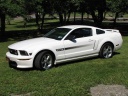
Hey that is one of the first CSs I have seen without hood scoops! Mine does not have one, and I love it. For a while I thought i was the only one.
Last edited by CSKoz; Jan 20, 2011 at 02:02 PM.
Team Mustang Source
Joined: August 23, 2004
Posts: 461
Likes: 0
From: Austin TX
And as far as GT/CS vs. Bullitt, I like 'em both the same. The only reason I went with the CS was that I was afraid of the gas mileage with the 3.73 rear. Here in a year or so I might go looking for a second Mustang again and the Bullitt is definitely on my list.
Last edited by jay_wx; Jan 20, 2011 at 04:20 AM.

Bullitt Member
Joined: September 21, 2008
Posts: 374
Likes: 0
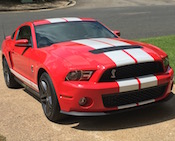
local dealer still has a shelby gt on the lot, cant give it away. too much money for very little more car over a bullitt or CS or GT.
bought it for the style?
Bullitt Member
Joined: September 10, 2009
Posts: 360
Likes: 1
From: Alabama
^^ Agreed! I shopped the Bullitt, Shelby GT and GT/CS before deciding on the GT/CS. Local dealer wanted 10k over sticker for the Bullitt, and the 10-12k extra for the Shelby is absurd for 2k worth of parts and Carroll's signature. I bought my GT/CS for 2k UNDER sticker and have spent less than 3k on mods that equal or exceed the Bullitt or Shelby performance. As for the fabled "Resale value"....I'm not ever selling so what difference does it make. As far as looks, the GT/CS is by far the best looking of the three.

Spam Connoisseur
I got هَبوبed
I got هَبوبed
Joined: September 8, 2009
Posts: 9,651
Likes: 7
From: Sun City AZ
it was a good deal..
and a shleby gt is a CS with more factory upgrades...

I paid 28k out the door with a gap and warranty..

hahah who pays retail? who lets retail choose what they buy? come on guys up your game.
and a shleby gt is a CS with more factory upgrades...
I paid 28k out the door with a gap and warranty..
hahah who pays retail? who lets retail choose what they buy? come on guys up your game.
Post *****
Joined: December 14, 2007
Posts: 19,953
Likes: 4
From: State of Jefferson Mountains USA
It did surprise me it had the mileage penalty. As I remember it had 3.55's, a CAI, and "said" 320HP, whereas Bullitt is 3.73's, CAI, and "said" 315HP - but Bullitt did not have mileage penalty.
Would that be because the Shelby GT came stock with a more aggressive tune that cost on mileage?