


Oil Filter


Bear Eats King...
Bear ****s Bone
Bear ****s Bone

Joined: September 5, 2011
Posts: 5,473
Likes: 2
From: Cleburne, Tx
What I was really trying to get at is... Is it worth the extra money when motorcraft synthetic blend gets the job done with no issues.
To me its kinda like welding two parts together when a nut and bolt is plenty good

To me its kinda like welding two parts together when a nut and bolt is plenty good

Mach 1 Member
Joined: August 1, 2011
Posts: 802
Likes: 0
From: Iowa
Can you quote me on where i said it was junk ! 
There are lots of very good oils out there, but there is also the better stuff, which is a "full" synthetic group 1V oil, but sometimes labels can be misleading if you don't know to interpret them.
Informative facts :
Synthetic motor oils are fuel efficient, extended life lubricants manufactured from select base stocks and special purpose additives. Synthetic oil base stocks are made from organic compounds or synthetic hydrocarbons using a process that re-arranges the structure so all the molecules are uniform in size, shape and weight, a phenomenon that does not occur in nature. In contrast to petroleum oils which are pumped from the earth and refined, synthetics are custom-designed to produce, in effect, the ideal lubricant.
In responding to the objections most commonly raised against synthetics it is important to establish the parameters of the debate. When speaking of synthetic motor oils, this article is defending the lubricants which have been formulated to meet the performance standards set by the American Petroleum Institute (API). (The first such synthetic motor oil independently tested and confirmed to meet these industry-accepted tests for defining engine oil properties and performance characteristics was AMSOIL 100% Synthetic 10W-40 in 1972.)
Many people with questions about synthetics haven't known where to turn to get correct information. Is it super oil or snake oil? Some enthusiasts will swear that synthetics are capable of raising your car from the dead. On the other hand, the next fellow asserts that synthetics will send your beloved car to an early grave. Where's the truth in all this?
In an effort to set the record straight, we've assembled here ten of the more persistent myths about synthetic motor oils to see how they stack up against the facts.
Myth #1: Synthetic motor oils damage seals.
Untrue. It would be foolhardy for lubricant manufacturers to build a product that is incompatible with seals. The composition of seals presents problems that both petroleum oils and synthetics must overcome. Made from elastomers, seals are inherently difficult to standardize.
Ultimately it is the additive mix in oil that counts. Additives to control seal swell, shrinkage and hardening are required, whether it be a synthetic or petroleum product that is being produced.
Myth #2: Synthetics are too thin to stay in the engine.
Untrue. In order for a lubricant to be classified in any SAE grade (10W-30, 10W-40, etc.) it has to meet certain guidelines with regard to viscosity ("thickness").
For example, it makes no difference whether it's 10W-40 petroleum or 10W-40 synthetic, at -25 degrees centigrade (-13F) and 100 degrees centigrade (212 degrees F) the oil has to maintain a standardized viscosity or it can't be rated a 10W-40.
Myth #3: Synthetics cause cars to use more oil.
Untrue. Synthetic motor oils are intended for use in mechanically sound engines, that is, engines that don't leak. In such engines, oil consumption will actually be reduced. First, because of the lower volatility of synlubes. Second, because of the better sealing characteristics between piston rings and cylinder walls. And finally, because of the superior oxidation stability (i.e. resistance of synthetics against reacting with oxygen at high temperatures.)
Myth #4: Synthetic lubricants are not compatible with petroleum.
Untrue. The synthesized hydrocarbons, polyalphaolefins, diesters and other materials that form the base stocks of high-quality name brand synthetics are fully compatible with petroleum oils. In the old days, some companies used ingredients that were not compatible, causing quality synlubes to suffer a bum rap. Fortunately, those days are long gone.
Compatibility is something to keep in mind, however, whether using petroleum oils or synthetics. It is usually best to use the same oil for topping off that you have been running in the engine. That is, it is preferable to not mix your oils, even if it is Valvoline or Quaker State you are using. The reason is this: the functions of additives blended for specific characteristics can be offset when oils with different additive packages are put together. For optimal performance, it is better to use the same oil throughout.
Myth #5: Synthetic lubricants are not readily available.
Untrue. This may have been the case two decades ago when AMSOIL and Mobil 1 were the only real choices, but today nearly every major oil company has added a synthetic product to their lines. This in itself is a testament to the value synthetics offer.
Myth #6: Synthetic lubricants produce sludge.
Untrue. In point of fact, synthetic motor oils are more sludge resistant than their petroleum counterparts, resisting the effects of high temperature and oxidation. In the presence of high temperatures, two things can happen. First, an oil's lighter ingredients boil off, making the oil thicker. Second, many of the complex chemicals found naturally in petroleum base stocks begin to react with each other, forming sludge, gum and varnish. One result is a loss of fluidity at low temperatures, slowing the timely flow of oil to the engine for vital component protection.
Further negative effects of thickened oil include the restriction of oil flow into critical areas, greater wear and loss of fuel economy.
Because of their higher flash points, and their ability to withstand evaporation loss and oxidation, synthetics are much more resistant to sludge development.
Two other causes of sludge -- ingested dirt and water dilution -- can be a problem in any kind of oil, whether petroleum or synthetic. These are problems with the air filtration system and the cooling system respectively, not the oil.
Myth #7: Synthetics can't be used with catalytic converters or oxygen sensors.
Untrue. There is no difference between synthetic and petroleum oils in regards to these components. Both synthetic and petroleum motor oils are similar compounds and neither is damaging to catalytic converters or oxygen sensors. In fact, because engines tend to run cleaner with synthetics, sensors and emission control systems run more efficiently and with less contamination.
Myth#8: Synthetics void warranties.
Untrue. Major engine manufacturers specifically recommend the use of synthetic lubricants. In point of fact, increasing numbers of high performance cars are arriving on showroom floors with synthetic motor oils as factory fill.
New vehicle warranties are based upon the use of oils meeting specific API Service Classifications (for example, SJ/CF). Synthetic lubricants which meet current API Service requirements are perfectly suited for use in any vehicle without affecting the validity of the new car warranty.
In point of fact, in the twenty-eight years that AMSOIL Synthetic Lubricants have been used in extended service situations, over billions of miles of actual driving, these oils have not been faulted once for voiding an automaker's warranty.
Myth #9: Synthetics last forever.
Untrue. Although some experts feel that synthetic base stocks themselves can be used forever, it is well known that eventually the additives will falter and cause the oil to require changing. Moisture, fuel dilution, and the by-products of combustion (acids and soot) tend to use up additives in an oil, allowing degradation to occur.
However, by "topping off", additives can be replenished. Through good filtration and periodic oil analysis, synthetic engine oils protect an engine for lengths of time far beyond the capability of non-synthetics.
Myth #10: Synthetics are too expensive.
Untrue. Tests and experience have proven that synthetics can greatly extend drain intervals, provide better fuel economy, reduce engine wear and enable vehicles to operate with greater reliability. This more than offsets initial price differences. All these elements combine to make synthetic engine oils more economical than conventional non-synthetics.
In Europe, synthetics have enjoyed increasing acceptance as car buyers look first to performance and long term value rather than initial price. As more sophisticated technology places greater demands on today's motor oils, we will no doubt see an increasing re-evaluation of oil buying habits in this country as well.
CONCLUSIONS
Since their inception, manufacturers of synthetic motor oils have sought to educate the public about the facts regarding synthetics, and the need for consumers to make their lubrication purchasing decisions based on quality rather than price. As was the case with microwave ovens or electric lights, a highly technological improvement must often overcome a fair amount of public skepticism and consumer inertia before it is embraced by the general population.
But the word is getting out as a growing number of motorists worldwide experience the benefits of synthetic lubrication. The wave of the future, in auto lubes, is well under way.
There are lots of very good oils out there, but there is also the better stuff, which is a "full" synthetic group 1V oil, but sometimes labels can be misleading if you don't know to interpret them.
Informative facts :
Synthetic motor oils are fuel efficient, extended life lubricants manufactured from select base stocks and special purpose additives. Synthetic oil base stocks are made from organic compounds or synthetic hydrocarbons using a process that re-arranges the structure so all the molecules are uniform in size, shape and weight, a phenomenon that does not occur in nature. In contrast to petroleum oils which are pumped from the earth and refined, synthetics are custom-designed to produce, in effect, the ideal lubricant.
In responding to the objections most commonly raised against synthetics it is important to establish the parameters of the debate. When speaking of synthetic motor oils, this article is defending the lubricants which have been formulated to meet the performance standards set by the American Petroleum Institute (API). (The first such synthetic motor oil independently tested and confirmed to meet these industry-accepted tests for defining engine oil properties and performance characteristics was AMSOIL 100% Synthetic 10W-40 in 1972.)
Many people with questions about synthetics haven't known where to turn to get correct information. Is it super oil or snake oil? Some enthusiasts will swear that synthetics are capable of raising your car from the dead. On the other hand, the next fellow asserts that synthetics will send your beloved car to an early grave. Where's the truth in all this?
In an effort to set the record straight, we've assembled here ten of the more persistent myths about synthetic motor oils to see how they stack up against the facts.
Myth #1: Synthetic motor oils damage seals.
Untrue. It would be foolhardy for lubricant manufacturers to build a product that is incompatible with seals. The composition of seals presents problems that both petroleum oils and synthetics must overcome. Made from elastomers, seals are inherently difficult to standardize.
Ultimately it is the additive mix in oil that counts. Additives to control seal swell, shrinkage and hardening are required, whether it be a synthetic or petroleum product that is being produced.
Myth #2: Synthetics are too thin to stay in the engine.
Untrue. In order for a lubricant to be classified in any SAE grade (10W-30, 10W-40, etc.) it has to meet certain guidelines with regard to viscosity ("thickness").
For example, it makes no difference whether it's 10W-40 petroleum or 10W-40 synthetic, at -25 degrees centigrade (-13F) and 100 degrees centigrade (212 degrees F) the oil has to maintain a standardized viscosity or it can't be rated a 10W-40.
Myth #3: Synthetics cause cars to use more oil.
Untrue. Synthetic motor oils are intended for use in mechanically sound engines, that is, engines that don't leak. In such engines, oil consumption will actually be reduced. First, because of the lower volatility of synlubes. Second, because of the better sealing characteristics between piston rings and cylinder walls. And finally, because of the superior oxidation stability (i.e. resistance of synthetics against reacting with oxygen at high temperatures.)
Myth #4: Synthetic lubricants are not compatible with petroleum.
Untrue. The synthesized hydrocarbons, polyalphaolefins, diesters and other materials that form the base stocks of high-quality name brand synthetics are fully compatible with petroleum oils. In the old days, some companies used ingredients that were not compatible, causing quality synlubes to suffer a bum rap. Fortunately, those days are long gone.
Compatibility is something to keep in mind, however, whether using petroleum oils or synthetics. It is usually best to use the same oil for topping off that you have been running in the engine. That is, it is preferable to not mix your oils, even if it is Valvoline or Quaker State you are using. The reason is this: the functions of additives blended for specific characteristics can be offset when oils with different additive packages are put together. For optimal performance, it is better to use the same oil throughout.
Myth #5: Synthetic lubricants are not readily available.
Untrue. This may have been the case two decades ago when AMSOIL and Mobil 1 were the only real choices, but today nearly every major oil company has added a synthetic product to their lines. This in itself is a testament to the value synthetics offer.
Myth #6: Synthetic lubricants produce sludge.
Untrue. In point of fact, synthetic motor oils are more sludge resistant than their petroleum counterparts, resisting the effects of high temperature and oxidation. In the presence of high temperatures, two things can happen. First, an oil's lighter ingredients boil off, making the oil thicker. Second, many of the complex chemicals found naturally in petroleum base stocks begin to react with each other, forming sludge, gum and varnish. One result is a loss of fluidity at low temperatures, slowing the timely flow of oil to the engine for vital component protection.
Further negative effects of thickened oil include the restriction of oil flow into critical areas, greater wear and loss of fuel economy.
Because of their higher flash points, and their ability to withstand evaporation loss and oxidation, synthetics are much more resistant to sludge development.
Two other causes of sludge -- ingested dirt and water dilution -- can be a problem in any kind of oil, whether petroleum or synthetic. These are problems with the air filtration system and the cooling system respectively, not the oil.
Myth #7: Synthetics can't be used with catalytic converters or oxygen sensors.
Untrue. There is no difference between synthetic and petroleum oils in regards to these components. Both synthetic and petroleum motor oils are similar compounds and neither is damaging to catalytic converters or oxygen sensors. In fact, because engines tend to run cleaner with synthetics, sensors and emission control systems run more efficiently and with less contamination.
Myth#8: Synthetics void warranties.
Untrue. Major engine manufacturers specifically recommend the use of synthetic lubricants. In point of fact, increasing numbers of high performance cars are arriving on showroom floors with synthetic motor oils as factory fill.
New vehicle warranties are based upon the use of oils meeting specific API Service Classifications (for example, SJ/CF). Synthetic lubricants which meet current API Service requirements are perfectly suited for use in any vehicle without affecting the validity of the new car warranty.
In point of fact, in the twenty-eight years that AMSOIL Synthetic Lubricants have been used in extended service situations, over billions of miles of actual driving, these oils have not been faulted once for voiding an automaker's warranty.
Myth #9: Synthetics last forever.
Untrue. Although some experts feel that synthetic base stocks themselves can be used forever, it is well known that eventually the additives will falter and cause the oil to require changing. Moisture, fuel dilution, and the by-products of combustion (acids and soot) tend to use up additives in an oil, allowing degradation to occur.
However, by "topping off", additives can be replenished. Through good filtration and periodic oil analysis, synthetic engine oils protect an engine for lengths of time far beyond the capability of non-synthetics.
Myth #10: Synthetics are too expensive.
Untrue. Tests and experience have proven that synthetics can greatly extend drain intervals, provide better fuel economy, reduce engine wear and enable vehicles to operate with greater reliability. This more than offsets initial price differences. All these elements combine to make synthetic engine oils more economical than conventional non-synthetics.
In Europe, synthetics have enjoyed increasing acceptance as car buyers look first to performance and long term value rather than initial price. As more sophisticated technology places greater demands on today's motor oils, we will no doubt see an increasing re-evaluation of oil buying habits in this country as well.
CONCLUSIONS
Since their inception, manufacturers of synthetic motor oils have sought to educate the public about the facts regarding synthetics, and the need for consumers to make their lubrication purchasing decisions based on quality rather than price. As was the case with microwave ovens or electric lights, a highly technological improvement must often overcome a fair amount of public skepticism and consumer inertia before it is embraced by the general population.
But the word is getting out as a growing number of motorists worldwide experience the benefits of synthetic lubrication. The wave of the future, in auto lubes, is well under way.


Banned
Joined: March 9, 2011
Posts: 16,242
Likes: 6
Originally Posted by montreal ponies
Can you quote me on where i said it was junk !
There are lots of very good oils out there, but there is also the better stuff, which is a "full" synthetic group 1V oil, but sometimes labels can be misleading if you don't know to interpret them.
Informative facts :
Synthetic motor oils are fuel efficient, extended life lubricants manufactured from select base stocks and special purpose additives. Synthetic oil base stocks are made from organic compounds or synthetic hydrocarbons using a process that re-arranges the structure so all the molecules are uniform in size, shape and weight, a phenomenon that does not occur in nature. In contrast to petroleum oils which are pumped from the earth and refined, synthetics are custom-designed to produce, in effect, the ideal lubricant.
In responding to the objections most commonly raised against synthetics it is important to establish the parameters of the debate. When speaking of synthetic motor oils, this article is defending the lubricants which have been formulated to meet the performance standards set by the American Petroleum Institute (API). (The first such synthetic motor oil independently tested and confirmed to meet these industry-accepted tests for defining engine oil properties and performance characteristics was AMSOIL 100% Synthetic 10W-40 in 1972.)
Many people with questions about synthetics haven't known where to turn to get correct information. Is it super oil or snake oil? Some enthusiasts will swear that synthetics are capable of raising your car from the dead. On the other hand, the next fellow asserts that synthetics will send your beloved car to an early grave. Where's the truth in all this?
In an effort to set the record straight, we've assembled here ten of the more persistent myths about synthetic motor oils to see how they stack up against the facts.
Myth #1: Synthetic motor oils damage seals.
Untrue. It would be foolhardy for lubricant manufacturers to build a product that is incompatible with seals. The composition of seals presents problems that both petroleum oils and synthetics must overcome. Made from elastomers, seals are inherently difficult to standardize.
Ultimately it is the additive mix in oil that counts. Additives to control seal swell, shrinkage and hardening are required, whether it be a synthetic or petroleum product that is being produced.
Myth #2: Synthetics are too thin to stay in the engine.
Untrue. In order for a lubricant to be classified in any SAE grade (10W-30, 10W-40, etc.) it has to meet certain guidelines with regard to viscosity ("thickness").
For example, it makes no difference whether it's 10W-40 petroleum or 10W-40 synthetic, at -25 degrees centigrade (-13F) and 100 degrees centigrade (212 degrees F) the oil has to maintain a standardized viscosity or it can't be rated a 10W-40.
Myth #3: Synthetics cause cars to use more oil.
Untrue. Synthetic motor oils are intended for use in mechanically sound engines, that is, engines that don't leak. In such engines, oil consumption will actually be reduced. First, because of the lower volatility of synlubes. Second, because of the better sealing characteristics between piston rings and cylinder walls. And finally, because of the superior oxidation stability (i.e. resistance of synthetics against reacting with oxygen at high temperatures.)
Myth #4: Synthetic lubricants are not compatible with petroleum.
Untrue. The synthesized hydrocarbons, polyalphaolefins, diesters and other materials that form the base stocks of high-quality name brand synthetics are fully compatible with petroleum oils. In the old days, some companies used ingredients that were not compatible, causing quality synlubes to suffer a bum rap. Fortunately, those days are long gone.
Compatibility is something to keep in mind, however, whether using petroleum oils or synthetics. It is usually best to use the same oil for topping off that you have been running in the engine. That is, it is preferable to not mix your oils, even if it is Valvoline or Quaker State you are using. The reason is this: the functions of additives blended for specific characteristics can be offset when oils with different additive packages are put together. For optimal performance, it is better to use the same oil throughout.
Myth #5: Synthetic lubricants are not readily available.
Untrue. This may have been the case two decades ago when AMSOIL and Mobil 1 were the only real choices, but today nearly every major oil company has added a synthetic product to their lines. This in itself is a testament to the value synthetics offer.
Myth #6: Synthetic lubricants produce sludge.
Untrue. In point of fact, synthetic motor oils are more sludge resistant than their petroleum counterparts, resisting the effects of high temperature and oxidation. In the presence of high temperatures, two things can happen. First, an oil's lighter ingredients boil off, making the oil thicker. Second, many of the complex chemicals found naturally in petroleum base stocks begin to react with each other, forming sludge, gum and varnish. One result is a loss of fluidity at low temperatures, slowing the timely flow of oil to the engine for vital component protection.
Further negative effects of thickened oil include the restriction of oil flow into critical areas, greater wear and loss of fuel economy.
Because of their higher flash points, and their ability to withstand evaporation loss and oxidation, synthetics are much more resistant to sludge development.
Two other causes of sludge -- ingested dirt and water dilution -- can be a problem in any kind of oil, whether petroleum or synthetic. These are problems with the air filtration system and the cooling system respectively, not the oil.
Myth #7: Synthetics can't be used with catalytic converters or oxygen sensors.
Untrue. There is no difference between synthetic and petroleum oils in regards to these components. Both synthetic and petroleum motor oils are similar compounds and neither is damaging to catalytic converters or oxygen sensors. In fact, because engines tend to run cleaner with synthetics, sensors and emission control systems run more efficiently and with less contamination.
Myth#8: Synthetics void warranties.
Untrue. Major engine manufacturers specifically recommend the use of synthetic lubricants. In point of fact, increasing numbers of high performance cars are arriving on showroom floors with synthetic motor oils as factory fill.
New vehicle warranties are based upon the use of oils meeting specific API Service Classifications (for example, SJ/CF). Synthetic lubricants which meet current API Service requirements are perfectly suited for use in any vehicle without affecting the validity of the new car warranty.
In point of fact, in the twenty-eight years that AMSOIL Synthetic Lubricants have been used in extended service situations, over billions of miles of actual driving, these oils have not been faulted once for voiding an automaker's warranty.
Myth #9: Synthetics last forever.
Untrue. Although some experts feel that synthetic base stocks themselves can be used forever, it is well known that eventually the additives will falter and cause the oil to require changing. Moisture, fuel dilution, and the by-products of combustion (acids and soot) tend to use up additives in an oil, allowing degradation to occur.
However, by "topping off", additives can be replenished. Through good filtration and periodic oil analysis, synthetic engine oils protect an engine for lengths of time far beyond the capability of non-synthetics.
Myth #10: Synthetics are too expensive.
Untrue. Tests and experience have proven that synthetics can greatly extend drain intervals, provide better fuel economy, reduce engine wear and enable vehicles to operate with greater reliability. This more than offsets initial price differences. All these elements combine to make synthetic engine oils more economical than conventional non-synthetics.
In Europe, synthetics have enjoyed increasing acceptance as car buyers look first to performance and long term value rather than initial price. As more sophisticated technology places greater demands on today's motor oils, we will no doubt see an increasing re-evaluation of oil buying habits in this country as well.
CONCLUSIONS
Since their inception, manufacturers of synthetic motor oils have sought to educate the public about the facts regarding synthetics, and the need for consumers to make their lubrication purchasing decisions based on quality rather than price. As was the case with microwave ovens or electric lights, a highly technological improvement must often overcome a fair amount of public skepticism and consumer inertia before it is embraced by the general population.
But the word is getting out as a growing number of motorists worldwide experience the benefits of synthetic lubrication. The wave of the future, in auto lubes, is well under way.


Cobra R Member
Joined: June 17, 2010
Posts: 1,666
Likes: 0
From: Southeastern Virginia
Eric,
I like you didn't know much about oil, that is until i started reading about it at Bob's the oil guy site and reading some good informing threads from people in the know at other different sites like SVT performance just to name that one.
Regular Mobil1 synthetic, is not a "true" synthetic oil, like i mentionned before it is a blend of dino oil and base synthetic. It makes for a good oil no doubt, but it is not "fully" synthetic.
On the other hand, Mobil1 Extended performance ( look for it on the label) is a "true" 100% synthetic oil, just like all the other ones i've mentionned in my post above.
I even i got the regular Mobil1 synthetic when doing my first oil change thinking i was getting the "real" stuff. Wrong i was !
Don't sweat it, keep the oil you have in there, it is good oil. But next time you'll know what to get. Just trying to be informative here, not trying to tell you to dump your new oil.
When in N-H this past week end, went to Walmart and checked out their prices on oil , their big jug of Mobil1 EP was about $25-28 or so, which compare to here is a steal. They retail at $51 cdn over here for the 4.4L ( 1L =1Quart), i got it on special for $38.
I like you didn't know much about oil, that is until i started reading about it at Bob's the oil guy site and reading some good informing threads from people in the know at other different sites like SVT performance just to name that one.
Regular Mobil1 synthetic, is not a "true" synthetic oil, like i mentionned before it is a blend of dino oil and base synthetic. It makes for a good oil no doubt, but it is not "fully" synthetic.
On the other hand, Mobil1 Extended performance ( look for it on the label) is a "true" 100% synthetic oil, just like all the other ones i've mentionned in my post above.
I even i got the regular Mobil1 synthetic when doing my first oil change thinking i was getting the "real" stuff. Wrong i was !
Don't sweat it, keep the oil you have in there, it is good oil. But next time you'll know what to get. Just trying to be informative here, not trying to tell you to dump your new oil.
When in N-H this past week end, went to Walmart and checked out their prices on oil , their big jug of Mobil1 EP was about $25-28 or so, which compare to here is a steal. They retail at $51 cdn over here for the 4.4L ( 1L =1Quart), i got it on special for $38.

Also, I read thru all of the Q&A on Pennzoil Ultra on the BITOG web site and Penn's reason for using 3 base stock for Ultra was that they were targeting the "total package" (my paraphrase) of oil performance with Ultra, rather than "concentrating on one parameter". Interesting. I also read thru M1's Q&A and I am sorry, but Mobil's answers seemed more evasive and less committal than Pennzoil's. Then again, Pennzoil limits its warranty to being applicable to oil changes of 4,000 miles max, whereas Mobil stands behind its M1XL for 15,000.
At the end of the day, I am still convinced that, for my average driving and my strict adherence to my maintenance minder, either of the Pennzoils or the M1XL would be equally fine at protecting my engine. But I still plan to give the M1 a try next time. Doesn't help we have to buy TWO of the gallon jugs....
As for THIS photo....:
Based on this photo, it looks like the factory filter on the Boss differs from that used on GTs. The factory filter I had on both my 2011 5.0 and my 2012 5.0 was a little longer than the FL500S, not shorter. Weird.
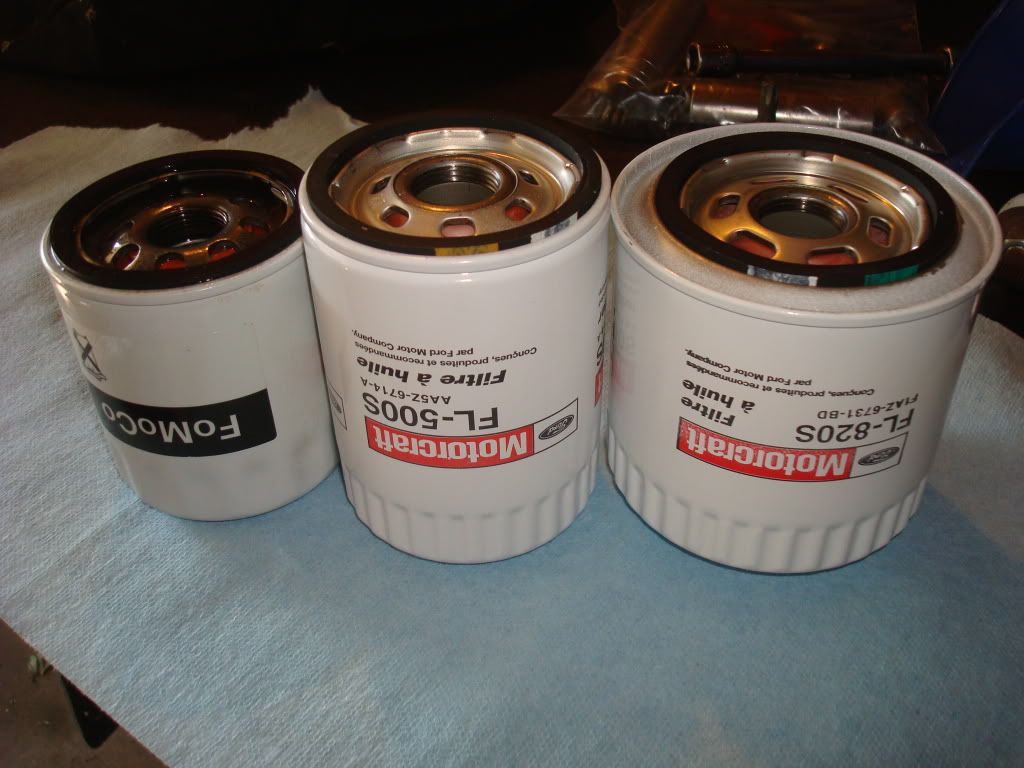
Last edited by Double-EDad; Oct 1, 2011 at 08:22 AM.


Cobra Member
Joined: March 14, 2007
Posts: 1,131
Likes: 6
From: South Dakota
I just bought Mobil 1, which I have been using since 1978, including three years on the Autobahn, in a Mustang.
They currently have a rebate program going on. Buy 5 Quarts and get $12.00 back, buy 10 quarts and get $24.00 back. I bought the ten quarts and sent it off.
In Europe BMW and Mercedes are using 15,000 mile oil changes. My wifes Turbo Passat wagon uses 10,000 mile changes, but only with Castrol Euro oil, which the dealer uses, and apparently is only available at the dealer. The car comes with free maintenace for the first three changes, so VW can specify which oil must be used. I plan to swtich to Mobil 1, for European cars when VWs' maintenance is over.
I used that in my '05 Chrysler Crossfire which had the Mercedes SLK drivetrain. Mercedes recommended the Mobil 1 Euro and the car came with it. I have always been happy with Mobil 1 performance, but then I usually change it every six months or 5000/7500 miles depending on my driving situation and the weather conditions.
They currently have a rebate program going on. Buy 5 Quarts and get $12.00 back, buy 10 quarts and get $24.00 back. I bought the ten quarts and sent it off.
In Europe BMW and Mercedes are using 15,000 mile oil changes. My wifes Turbo Passat wagon uses 10,000 mile changes, but only with Castrol Euro oil, which the dealer uses, and apparently is only available at the dealer. The car comes with free maintenace for the first three changes, so VW can specify which oil must be used. I plan to swtich to Mobil 1, for European cars when VWs' maintenance is over.
I used that in my '05 Chrysler Crossfire which had the Mercedes SLK drivetrain. Mercedes recommended the Mobil 1 Euro and the car came with it. I have always been happy with Mobil 1 performance, but then I usually change it every six months or 5000/7500 miles depending on my driving situation and the weather conditions.


Team Mustang Source
Joined: January 30, 2004
Posts: 3,738
Likes: 0
From: Montreal
Was told by my dealership to stick with FL500s filter for my GT, i specifically asked about the possibility of using the FL820 one, but they said it wasn't intended to use with the GT cars. Oh well, so i got the 500 one.
Team Mustang Source
Joined: January 30, 2004
Posts: 3,738
Likes: 0
From: Montreal
Team Mustang Source
Joined: January 30, 2004
Posts: 3,738
Likes: 0
From: Montreal
Question: My owners manual specifies 5w20 oil. Do I really need to use 5w20 oil and why did my 2000 model year vehicle require a 5w30 oil, while the exact same engine in my 2001 model year vehicle requires 5w20 oil?
Answer: No. You do not need to use a 5w20 oil. The only reason 5w20 was specified for your engine is to increase the CAFE (Corporate Average Fuel Economy) reported to the Federal Government. CAFE is the combined average fuel economy of all of a vehicle manufacturer's product line. Minimum CAFE levels are specified by the Federal Government. In order for a vehicle manufacturer to continue selling profitable large trucks and SUV's, which typically have poor fuel mileage, and still meet mandated CAFE requirements, they must also sell smaller cars which have much better fuel economy ratings to offset the poor fuel economy ratings of the larger vehicles.
For model year 2001, the change to 5w20 oil will allow a vehicle manufacturer's overall CAFE to decrease by a very small amount, typically in the tenths of a mile per gallon range. 5w20 oil is a lighter viscosity than a 5w30 oil and therefore has less internal engine frictional losses, or less drag on the crankshaft, pistons and valve-train. This decrease in frictional power loss promotes increased fuel economy. This increased fuel economy is virtually undetectable to the average consumer without the use of specialized engine monitoring and testing equipment when compared to a 5w30, 10w30 or a 0w30 viscosity motor oil.
Question: What are the negative aspects of using a 5w20 oil?
Answer: 5w20 oil has less film and shear strength than a 5w30, 10w30 or a 0w30 motor oil. This can lead to increased engine wear under today's demanding heat and high-stress engine performance conditions.
Question: Is the above true of synthetics as well?
Answer: Yes and no. Depends upon what you're comparing. A 5w20 synthetic oil will likely have less film and shear strength than a synthetic 5w30, 10w30 or 0w30. However, if you compare that same synthetic 5w20 motor oil to a petroleum 5w30, or 10w30, it will likely have better film and shear strength.
Obviously, this means it will certainly have better film and shear strength than a petroleum 5w20 oil. So, if you'd feel more comfortable sticking with the manufacturer recommended 5w20, go with a quality synthetic oil.
Question: Don't I have to use a 5w20 oil to maintain my factory warranty if my manual recommends a 5w20 oil? Answer: Absolutely not. Vehicle manufacturers recommend using motor oils meeting certain viscosity grades and American Petroleum Institute service requirements. Whether the motor oil is a 5w20, 5w30, 10w30 or 0w30 or even a synthetic vs. a petroleum-based oil will not affect warranty coverage. The manufacturer is required to cover all equipment failures it would normally cover as long as the oil meets API service requirements and specifications and was not the cause of the failure.


Post *****
Joined: October 9, 2007
Posts: 32,808
Likes: 163
I hate that Ford wants me to use 5w-20 in all these cars and trucks I have.
Everything from my 2007 Expedition to the 2007 GT to the 2010 Raptor requires it. I don't think it's intended for use in South Texas.
And as far as the true synthetic oils it is my understanding that the synthetics never wear out but the additives do. Otherwise you could run the true synthetic forever. You would need only add the additives. But it's just better to change the oil.
I am no tech or expert, but I general change mine at about 1,500 miles at first and then follow 5k for synthetics. Sure it can go longer, but all in all it's cheaper than a tank of gas.
Everything from my 2007 Expedition to the 2007 GT to the 2010 Raptor requires it. I don't think it's intended for use in South Texas.
And as far as the true synthetic oils it is my understanding that the synthetics never wear out but the additives do. Otherwise you could run the true synthetic forever. You would need only add the additives. But it's just better to change the oil.
I am no tech or expert, but I general change mine at about 1,500 miles at first and then follow 5k for synthetics. Sure it can go longer, but all in all it's cheaper than a tank of gas.

Cobra Member
Joined: May 25, 2005
Posts: 1,267
Likes: 0
From: Skopje, Macedonia
The FL820 from just looking at the picture appears to be the better filter. Did your dealer give you a reason why it wasn't intended for use with the GT? Just because it wasn't intended for use doesn't exactly mean it shouldn't be. If the FL820 is a better filter I see no problem with using it.
Mach 1 Member
Joined: August 1, 2011
Posts: 802
Likes: 0
From: Iowa
The Boss and GT500's comes from the factory with 5w50 but it breaks down to a mid 30 grade after some use.

Post *****
Joined: December 14, 2007
Posts: 19,953
Likes: 4
From: State of Jefferson Mountains USA
Boy you Canadians love pushing that eh? Where's Everett?
If in fact its true that Ford only changed from 5w-30 - 5w-20 because of CAFE - engine longevity (and customer) be damned, then why didn't Chrysler also drop to 5w-20??
I have a 2010 Chrysler winter car, had a 2008, and both spec the same 5w-30 that was spec'd on the 2000 engine. Same exact 4 banger. That was engineered with tolerances that spec'd 5w-30. Lord knows the engine and Chrysler could use the bump in mileage. But they didn't drop - yet are under the same CAFE as Ford.
Internet rumor.

Use what Ford specs. Most wear starts at cold engine start up. Especially with overhead cam engines. The thicker viscosity you use (esp when thicker than factory specs) the more wear you induce at start up.
I'm stickin' with 5w-20 synth blend and changing it at 5k. (Although I only put 3k/yr on 901 so it gets changed before winter storage to get blow-by contaminents out of the crankcase.)
Last edited by cdynaco; Oct 2, 2011 at 09:39 AM.
Team Mustang Source
Joined: January 30, 2004
Posts: 3,738
Likes: 0
From: Montreal
I'll take that as a compliment...thank you !
Click this link:
http://www.machinerylubrication.com/Read/518/motor-oils
Click this link:
http://www.machinerylubrication.com/Read/518/motor-oils
Post *****
Joined: December 14, 2007
Posts: 19,953
Likes: 4
From: State of Jefferson Mountains USA


Mach 1 Member
Joined: May 24, 2010
Posts: 873
Likes: 1
From: MA
Cdynaco,
You are wrong!!! Ford doesn't care about engine longevity. Is not like they have a reputation, one they worked so hard to improve in the recent years, to protect. I mean if all Ford engines break down around 100,000 miles, do you think people are going to start buying from the competition instead? You crazy.
You are wrong!!! Ford doesn't care about engine longevity. Is not like they have a reputation, one they worked so hard to improve in the recent years, to protect. I mean if all Ford engines break down around 100,000 miles, do you think people are going to start buying from the competition instead? You crazy.

