


Excessive axle hop?


Mach 1 Member

Joined: August 28, 2005
Posts: 626
Likes: 16
From: Winnipeg Mb. Ca
I think the stamped steel LCA are used because Ford can attach a couple of NVH dampers to each LCA. They have to produce a product that not only reduces wheel hop but also gives a quality ride while operating in all weather extremes.
Mach 1 Member
Joined: December 1, 2006
Posts: 860
Likes: 0
I was able to completely eliminate wheel hop and the "getting jerked sideways" feeling while hitting a bump with the rear while accelerating.
A lot of this is caused by the poor rear shocks Ford puts on these cars. I did the Koni STR.T dampers and Steeda Sports springs. I installed the steeda panhard bar and brace at the same time but I credit most of the result to the shocks. That panhard couldn't have hurt though.
A lot of this is caused by the poor rear shocks Ford puts on these cars. I did the Koni STR.T dampers and Steeda Sports springs. I installed the steeda panhard bar and brace at the same time but I credit most of the result to the shocks. That panhard couldn't have hurt though.
legacy Tms Member
Joined: October 9, 2005
Posts: 2,607
Likes: 77
From: N.E. Ohio
I've noticed on several occasions where I try to launch on wet pavement (while it is raining for example) that the car exhibits severe axle hop when it is not getting any traction. It happens in first gear and second gear at sub-3000 RPM. The entire rear of the car starts to vibrate badly. The only time I have encountered this on another RWD car is on my 2000 Crown Vic but only when I lose traction in reverse. The Vic has a stock Watt's Linkage rear suspension.
My 07 GT did this before the Hellwig rear sway bar, so I don't believe the bar has anything to do with this.
Any ideas? Is it just the inherent design of the S197?
My 07 GT did this before the Hellwig rear sway bar, so I don't believe the bar has anything to do with this.
Any ideas? Is it just the inherent design of the S197?


Thread Starter
Legacy TMS Member
Joined: October 2, 2006
Posts: 4,777
Likes: 16
From: Southeast Michigan
randy: I do notice that the rear shocks have too much rebound dampening (stiff). Going over the dragon teeth / spike strips at work, the front tracks the bumps but the rear just sort of bounces down. The compression dampening seems OK but the rebound dampening needs to be softer.
Cobra Member
Joined: February 14, 2005
Posts: 1,075
Likes: 0
Wheel hop is not a one size fits all situation and can be approached in different ways to be resolved.
Depending on your horsepower level and how you drive you car, you may get wheel hop or you might not.
The most common cause of wheel hop is typically the deflection that occurs from soft bushings and flexing of the trailing arms themselves. However some of you have reported just doing springs and shocks to get rid of wheel hop. The reason for that is the change in geometry that occurs when you lower the car.
In simple terms, lowering the car changes your rear suspension geometry and reduces weight transfer. If you have stock control arms and you are reducing weight transfer you are reducing the loads on the suspension that produce the suspension deflection associated with wheel hop, hence wheel hop tends to go away.
However the underlying cause is really the rear trailing arms and their soft bushings. Whenever I get a customer on the phone trying to resolve a wheel hop issue I immediately suggest a set of rear lower arms. For most people this alone will take care of 90 to 100% of their wheel hop issues.
Higher horsepower and aggressive driving styles can still leave room for some wheel hop if you still have the stock upper 3rd link and bushings. Replacing the upper 3rd link after the lowers are done or doing both at the same time will eliminate wheel hop completely at any power level for a street car on street tires/drag radials. If you regularly drive on slicks you will have to compromise on your bushing choice and move away from full urethane to a urethane/spherical bushing combination if you want longevity. Bushing failure can become an issue with slicks/high rpm launches and you will also introduce significant NVH (noise, vibration, harshness) into the vehicle.
Now concerning NVH, that is also a common issue that makes customers hesistant to change their arms and simply live with the wheel hop. There are several sources of noises that can come up from a rear control arm swap. Most are driveline related.
The most common driveline related noises are rear end noise in the form of whines and groans, or actual driveline clunks. Ford allows for a pretty wide production variance in rear end setup knowing the stock control arms will do good job of soaking up any noise if the rear end is slightly out of spec. Put a set of control arms on and if you have a car with a gearset on the outer edge of setup you may hear a gear whine or groaning that wasnt there before or in some cases was there but you werent sure what it was. I had a customer in our Florida shop just last week with a GT500 that had gear whine that was loud enough to be heard on the stock suspension. Most aftermarket arms with urethane bushings would have made that noise more noticeable.
The other noise you get in an actual driveline clunking. Usually occuring during low speed driving where you are engaging and disengaging the clutch, but also can occur during shifting at speed. This noise is driveshaft related.
The rear shaft where it connects to the rear end does not use a U-joint, it uses a rotating coupling. If you were to take the driveshaft and disconnect it from the car, then put your hand on the rear joint and try to rotate it by hand, you would be able to feel the slop that is there with your hand alone. That is the cause of the noise.
To solve this issue I don't recommend taking a step backwards and installing the stock arms back into the car, but to actually replace the driveshaft with a 1 piece unit.
A 1 piece shaft will typically get rid of 90 to 95% of those noises, plus its worth 20+lbs of weight reduction and will improve acceleration times by 2 tenths of a second through the 1/4 mile. Any remaining noise will depend on how tight the rear end was set up from the factory. It makes a huge difference and I had customers call me back just to tell me how the driveshaft made their car feel better than new with all the noises gone.
Speaking for our trailing arms specifically, we have both our chrome moly alloy steel arms and billet trailing arms. Both use similar bushing packages and we claim that both will not increase NVH when installed in the vehicle.
For our chrome moly alloy steel rear trailing arms, about 1 in 50 we sell may get a report of noise from the customer. Usually only slight and not excessive but as every person in this thread knows what is excessive or not is a customer preference.
The 1 in 50 having noise is due to my explanation above about the variance you get in cars and the way the rear ends are set up from the factory. Its hit or miss and every car is different.
However we also have our billet rear trailing arms. The billet aluminum construction vs chrome moly alloy steel has a significant advantage when in comes to NVH control. Best way I can describe it is the aluminum acts like a tuning fork and helps soak up the frequencies that produce NVH.
Our billet aluminum arms despite their urethane bushing package are the closest to O.E. when it comes to being quiet and noise free. You may still get the drivetrain clunk I mentioned above with any aftermarket control arm including ours, but gear whine/groan should be virtually non-existent on our billet trailing arms unless you have some serious issues inside the rear end.
So if you want to control wheel hop and are afraid of noise, our billet arms are your best bet for near O.E smoothness and quiet operation. Just also be aware of the drivetrain clunks that could occur as mentioned earlier and the driveshaft solution. I know that may be out of budget for some, but if you can save up and do it right, you will be rewarded with a noise free vehicle that accelerates harder and is more responsive as well making your vehicle a joy to drive hard and a pleasure to just cruise around in.
Depending on your horsepower level and how you drive you car, you may get wheel hop or you might not.
The most common cause of wheel hop is typically the deflection that occurs from soft bushings and flexing of the trailing arms themselves. However some of you have reported just doing springs and shocks to get rid of wheel hop. The reason for that is the change in geometry that occurs when you lower the car.
In simple terms, lowering the car changes your rear suspension geometry and reduces weight transfer. If you have stock control arms and you are reducing weight transfer you are reducing the loads on the suspension that produce the suspension deflection associated with wheel hop, hence wheel hop tends to go away.
However the underlying cause is really the rear trailing arms and their soft bushings. Whenever I get a customer on the phone trying to resolve a wheel hop issue I immediately suggest a set of rear lower arms. For most people this alone will take care of 90 to 100% of their wheel hop issues.
Higher horsepower and aggressive driving styles can still leave room for some wheel hop if you still have the stock upper 3rd link and bushings. Replacing the upper 3rd link after the lowers are done or doing both at the same time will eliminate wheel hop completely at any power level for a street car on street tires/drag radials. If you regularly drive on slicks you will have to compromise on your bushing choice and move away from full urethane to a urethane/spherical bushing combination if you want longevity. Bushing failure can become an issue with slicks/high rpm launches and you will also introduce significant NVH (noise, vibration, harshness) into the vehicle.
Now concerning NVH, that is also a common issue that makes customers hesistant to change their arms and simply live with the wheel hop. There are several sources of noises that can come up from a rear control arm swap. Most are driveline related.
The most common driveline related noises are rear end noise in the form of whines and groans, or actual driveline clunks. Ford allows for a pretty wide production variance in rear end setup knowing the stock control arms will do good job of soaking up any noise if the rear end is slightly out of spec. Put a set of control arms on and if you have a car with a gearset on the outer edge of setup you may hear a gear whine or groaning that wasnt there before or in some cases was there but you werent sure what it was. I had a customer in our Florida shop just last week with a GT500 that had gear whine that was loud enough to be heard on the stock suspension. Most aftermarket arms with urethane bushings would have made that noise more noticeable.
The other noise you get in an actual driveline clunking. Usually occuring during low speed driving where you are engaging and disengaging the clutch, but also can occur during shifting at speed. This noise is driveshaft related.
The rear shaft where it connects to the rear end does not use a U-joint, it uses a rotating coupling. If you were to take the driveshaft and disconnect it from the car, then put your hand on the rear joint and try to rotate it by hand, you would be able to feel the slop that is there with your hand alone. That is the cause of the noise.
To solve this issue I don't recommend taking a step backwards and installing the stock arms back into the car, but to actually replace the driveshaft with a 1 piece unit.
A 1 piece shaft will typically get rid of 90 to 95% of those noises, plus its worth 20+lbs of weight reduction and will improve acceleration times by 2 tenths of a second through the 1/4 mile. Any remaining noise will depend on how tight the rear end was set up from the factory. It makes a huge difference and I had customers call me back just to tell me how the driveshaft made their car feel better than new with all the noises gone.
Speaking for our trailing arms specifically, we have both our chrome moly alloy steel arms and billet trailing arms. Both use similar bushing packages and we claim that both will not increase NVH when installed in the vehicle.
For our chrome moly alloy steel rear trailing arms, about 1 in 50 we sell may get a report of noise from the customer. Usually only slight and not excessive but as every person in this thread knows what is excessive or not is a customer preference.
The 1 in 50 having noise is due to my explanation above about the variance you get in cars and the way the rear ends are set up from the factory. Its hit or miss and every car is different.
However we also have our billet rear trailing arms. The billet aluminum construction vs chrome moly alloy steel has a significant advantage when in comes to NVH control. Best way I can describe it is the aluminum acts like a tuning fork and helps soak up the frequencies that produce NVH.
Our billet aluminum arms despite their urethane bushing package are the closest to O.E. when it comes to being quiet and noise free. You may still get the drivetrain clunk I mentioned above with any aftermarket control arm including ours, but gear whine/groan should be virtually non-existent on our billet trailing arms unless you have some serious issues inside the rear end.
So if you want to control wheel hop and are afraid of noise, our billet arms are your best bet for near O.E smoothness and quiet operation. Just also be aware of the drivetrain clunks that could occur as mentioned earlier and the driveshaft solution. I know that may be out of budget for some, but if you can save up and do it right, you will be rewarded with a noise free vehicle that accelerates harder and is more responsive as well making your vehicle a joy to drive hard and a pleasure to just cruise around in.
Mach 1 Member
Joined: December 1, 2006
Posts: 860
Likes: 0
I believe that is exactly why but not sure if softer is quite it. It's more of a recovery thing. Personally I think the lower arms can fix it but if you are looking to lower anyway you should go that route first and put the money in the HD strut mounts to fix the front end alignment and get the benefit of their quality and as long as the drop isn't too much you can get by without touching the rear lower arms. If you are putting down more power it may be time to move on to the arms along with wider tires back there.
It's definitely a matter of finding the right mix for what you want out of your car and thinking ahead far enough to get there without spending a load. I'm a big fan of what steeda has to offer and they offer about everything too.
It's definitely a matter of finding the right mix for what you want out of your car and thinking ahead far enough to get there without spending a load. I'm a big fan of what steeda has to offer and they offer about everything too.
randy: I do notice that the rear shocks have too much rebound dampening (stiff). Going over the dragon teeth / spike strips at work, the front tracks the bumps but the rear just sort of bounces down. The compression dampening seems OK but the rebound dampening needs to be softer.
Last edited by randy_tho; Jul 26, 2011 at 09:56 PM.

Cobra Member
Joined: February 14, 2005
Posts: 1,075
Likes: 0
We've got an excellent durability record and our arms will not brittle over time. We have a customer who unfortunately wrecked his GT500, nearly totalled it with severe rear end damage, but the Steeda arm did not break, granted it was not usable afterwards, but it held.
This arm had years of service on it. If it was brittle it would have snapped...see below.
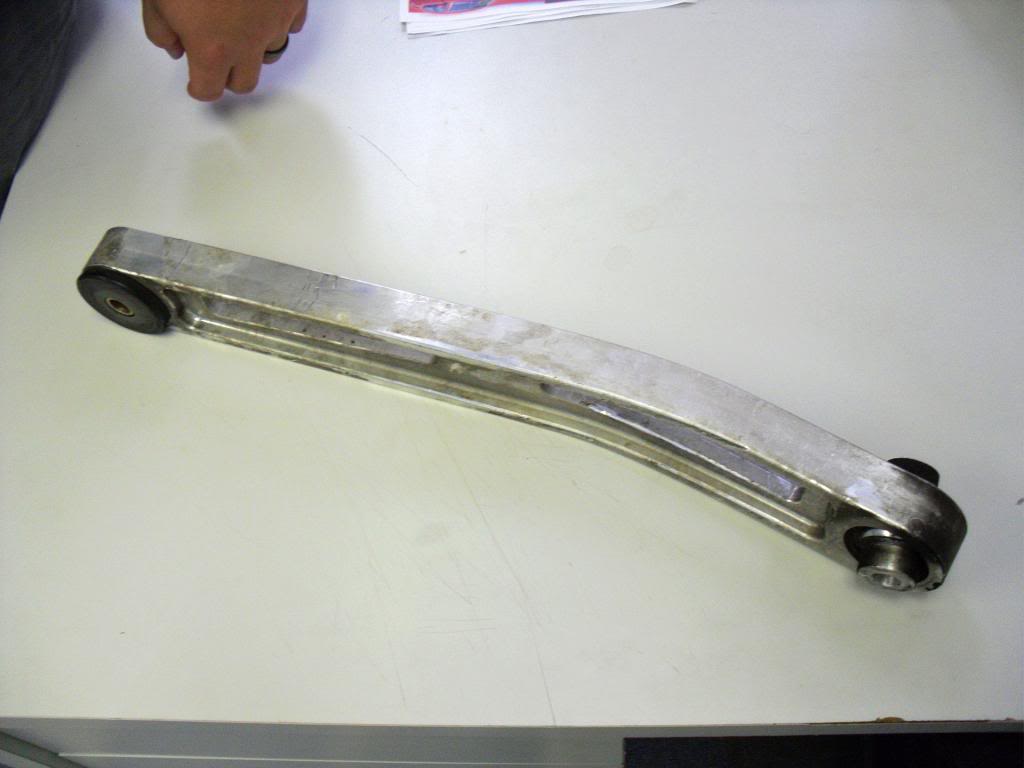
This arm had years of service on it. If it was brittle it would have snapped...see below.
Thread Starter
Legacy TMS Member
Joined: October 2, 2006
Posts: 4,777
Likes: 16
From: Southeast Michigan
Wow, that is impressive! I also notice the billet arms have a different bushing design than the tubular steel arms. I'm pretty sure I'll be ordering the billet arms for my GT.

Thread
Thread Starter
Forum
Replies
Last Post
Rando
2010-2014 Mustang
8
Aug 25, 2021 11:12 AM
Rando
2010-2014 Mustang
15
Sep 30, 2015 12:28 PM
tj@steeda
2015 - 2023 MUSTANG
0
Sep 24, 2015 08:15 PM
tj@steeda
2015 - 2023 MUSTANG
0
Sep 10, 2015 12:44 PM