


Electronic vs Mechical Guage ?

Thread Starter
GT Member

Joined: January 29, 2005
Posts: 106
Likes: 0
Electronic vs Mechical Guage ?
Want to get boost and fuel pressure gauges for my Paxton HO install. What are pros and cons on electronic vs mechical guages. The most obvious is price. I can save over $200 with mech. I am looking at the Autometer Cobalt series. I plan to mount them in a two gauge cluster on the steering column.
Bullitt Member
Joined: October 5, 2006
Posts: 294
Likes: 0
I have a mechanical boost gauge. For me, the best two things were the price, and the gauge only goes to 20psi (instead of 30). My gauge initially made a little rattle noise, but after about a month it broke in and is silent. I know that the fuel pressure gauge is dangerous to put inside the cockpit.

Team Mustang Source
Joined: January 30, 2004
Posts: 2,298
Likes: 4
From: Tampa FL

Putting a mechanical FP gauge in the interior of the car is a PITA. You have to put an isolator in line between the fuel rail and the gauge. The isolator has a diaphragm in it, and the fluid is basically coolant (yep, the same kind as in your radiator) so it mimics the pressure without actually having fuel go into the interior. I'd highly recommend bucking up and getting an electronic FP - infinitely easier to install and no worries about leaks in the interior.
Here's a pic of it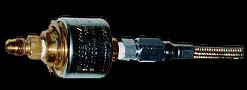 and an article detailing what's involved with the installation: http://www.thirdgen.org/fuelgauge
Here's a pic of it
and an article detailing what's involved with the installation: http://www.thirdgen.org/fuelgauge
Thread Starter
GT Member
Joined: January 29, 2005
Posts: 106
Likes: 0
I am certainly hearing that from my friends on wideband O2. If I go mech boost can save about ~$100 for a WB. Any recommendations.

Shelby GT500 Member
Joined: September 2, 2004
Posts: 2,594
Likes: 0
From: Chicago

Shelby GT350 Member
Joined: February 24, 2005
Posts: 2,227
Likes: 22
From: Delray Beach , FL
I have the AeroForces scan gauges and I use one of them for boost. I had to install a MAP sensor and run it to one of the analog inputs. The gauges read the fuel pressure directly from the computer , along with a lot of the other stock sensors. I already had a wideband gauge , but the you can hook a wideband O2 sensor up to one of the analog inputs for the A/F ratio too ...
Thread Starter
GT Member
Joined: January 29, 2005
Posts: 106
Likes: 0
I have the AeroForces scan gauges and I use one of them for boost. I had to install a MAP sensor and run it to one of the analog inputs. The gauges read the fuel pressure directly from the computer , along with a lot of the other stock sensors. I already had a wideband gauge , but the you can hook a wideband O2 sensor up to one of the analog inputs for the A/F ratio too ...

Shelby GT350 Member
Joined: February 24, 2005
Posts: 2,227
Likes: 22
From: Delray Beach , FL
The gauges read most sensors that the computer monitors , the fuel pressure is one of them and doesn't require anything else. The boost , which I needed , needs a MAP sensor which they sell and is hooked up to one of the Analog inputs. I already had a wideband A/F gauge , but you can hook up a wideband O2 sensor which they also sell and again hook it up to one of the analog inputs. You can do the same with oil pressure and other sensors the computer doesn't monitor. Yes , it is the one that has shift lights , actually you set them to activate for different conditions. You can set the gauge to activate the light when some parameter is a above or below some limit , such as your speed is above some limit or your fuel is below some limit , etc. They also have a pretty cool record function. I have two gauges with one of them set to monitor boost and fuel pressure and the other one set to monitor RPM and ignition advance. The gauges will record about 1 - 2 minutes of data and then you can play it back one frame at a time. The way I have my gauges configured , I can look at what my boost , fuel pressure and ignition advance are for each RPM range ...

Bullitt Member
Joined: August 13, 2007
Posts: 342
Likes: 0
That's always been my major complaint with the scan-type gauges. I looked VERY hard at the Interceptor when I was gauge shopping, and in the end wound up going old-school: analog gauges with needles.
I personally find digital numbers much harder to read out of the corner of my eye, and if a needle drifts away from where I'm used to seeing it, it's a lot more obvious peripherally than a digit change, particularly if you have multiple data displayed.
The gauges that I wound up going with are from ProSport's premium line. I picked up water temp, oil pressure and oil temp. I also like them for the alarm function. If, for example, the oil pressure drops below a user-adjustable threshold, the gauge starts beeping, AND the whole gauge face starts flashing a deep blood-red, that's really hard to ignore. It's not a small LED, it's the whole gauge face...
Here's a pic of the setup in the new SOS dash-pod...


Team Mustang Source
Joined: April 22, 2004
Posts: 468
Likes: 0
So will this problem exist with any electric fuel pressure guage or just the one run through ODB-II?
Many here have said that with a good wideband the fuel pressure is not as critical. I'm looking to go with 3 guages max, and there's some appeal to having a multi-function, a dedicated wideband, and boost.
-Darth
Many here have said that with a good wideband the fuel pressure is not as critical. I'm looking to go with 3 guages max, and there's some appeal to having a multi-function, a dedicated wideband, and boost.
-Darth
Bullitt Member
Joined: August 13, 2007
Posts: 342
Likes: 0
A stand-alone (electrical or mechanical) fuel pressure gauge, tied into the fuel rails will correctly monitor the actual line pressure. The scan gauges, such as the Interceptor, use the OBD fuel pressure reading, which is a delta (differential) reading.
I don't have FI on my car, but logic would dictate that any irregularities in fuel pressure that would cause issues with a blower would absolutely show up on a wideband. I have the DynoJet Wideband Commander, and you can set up an alarm function on the gauge (a yellow LED in the gauge face) to turn on under given conditions. For FI use, I would set the alarm thresholds at 0.1 or 0.2 AFR over the commanded ratio (11.6 or whatever) when the TPS reads WOT. That way you won't have spurious alarms when just cruising around and the computer pulls the mixture to stociometric, since the alarm only keys to WOT operation.
I think your selection of gauges (wideband, boost, OBD) makes a great deal of sense. I track my car, so my monitoring needs are a bit different.
I don't have FI on my car, but logic would dictate that any irregularities in fuel pressure that would cause issues with a blower would absolutely show up on a wideband. I have the DynoJet Wideband Commander, and you can set up an alarm function on the gauge (a yellow LED in the gauge face) to turn on under given conditions. For FI use, I would set the alarm thresholds at 0.1 or 0.2 AFR over the commanded ratio (11.6 or whatever) when the TPS reads WOT. That way you won't have spurious alarms when just cruising around and the computer pulls the mixture to stociometric, since the alarm only keys to WOT operation.
I think your selection of gauges (wideband, boost, OBD) makes a great deal of sense. I track my car, so my monitoring needs are a bit different.
Shelby GT350 Member
Joined: February 24, 2005
Posts: 2,227
Likes: 22
From: Delray Beach , FL
Dave , I didn't know we had a map sensor , that's why I had to add one for the Interceptor gauge. Also , I have 39# injectors and that's what my Interceptor gauge reads at idle , should it be reading something else ?
Bullitt Member
Joined: August 13, 2007
Posts: 342
Likes: 0
We don't have a MAP sensor, but we do have MAP: Manifold Absolute Pressure. The vacuum line that feeds the fuel rail interacts with the computer to modulate the FPDM, which gives the standard pressure commanded by the tune.
I'm not 100% positive, but I believe that your idle reading matching the injector rating is correct. If you monitor it, you'll notice that it never fluctuates, except perhaps a hair. Assuming that your injectors are flowing 39PSI at essentially atmospheric pressure, then if you add 8lbs of boost, the computer would need to hike the line pressure by 8PSI to keep things even. The fuel-pressure delta is equal to the difference of rail pressure and manifold pressure. Thus, at stock, you're seeing 39=39PSI-0PSI, and at max boost you're seeing 39=47PSI-8PSI. At least, that's the way I understand it. Otherwise, if the rail pressure was constant, when you went into boost, the actual fuel flow would drop (lower differential pressure) and the engine would lean out, which is exactly what you don't want...
I'm not 100% positive, but I believe that your idle reading matching the injector rating is correct. If you monitor it, you'll notice that it never fluctuates, except perhaps a hair. Assuming that your injectors are flowing 39PSI at essentially atmospheric pressure, then if you add 8lbs of boost, the computer would need to hike the line pressure by 8PSI to keep things even. The fuel-pressure delta is equal to the difference of rail pressure and manifold pressure. Thus, at stock, you're seeing 39=39PSI-0PSI, and at max boost you're seeing 39=47PSI-8PSI. At least, that's the way I understand it. Otherwise, if the rail pressure was constant, when you went into boost, the actual fuel flow would drop (lower differential pressure) and the engine would lean out, which is exactly what you don't want...

Thread
Thread Starter
Forum
Replies
Last Post