


2011 Challenger

Thread Starter
Team Mustang Source

Joined: January 31, 2004
Posts: 3,045
Likes: 2
From: NYC











Bullitt Member
Joined: March 25, 2004
Posts: 401
Likes: 0
Is it heresy to offer up the suggestion that the new V6 offerings from Dodge, Ford, and Chevy are now offering the best bang for the buck, over their V8 counterparts? (BFTB).
It is mind boggling that the new 3.7 nearly matches the performance of my 2006 GT and is capable of achieving around 30MPG on the highway. Though maybe it is just me, but I think the new LT/LS is a better base offering than the Camaro ever had before and I think it reflects more effort on GM’s part than they put forward on their V8 offering.
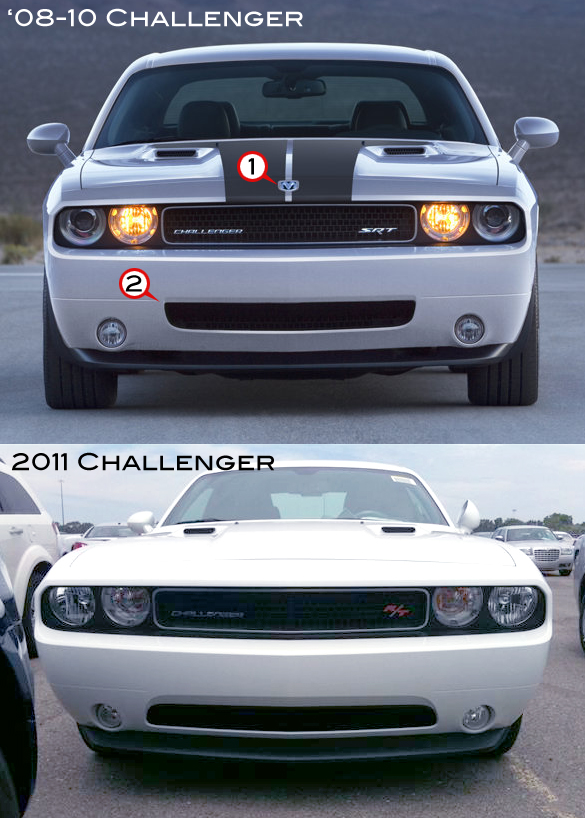
If the new Pentastar V6 comes close to the 300 HP mark (I am reading 280-290 HP in different publications) the same maybe true of the new model Dodge Challenger. The current V6 offering tips the scale at 3720, which is actually lighter than the current Camaro LS (though still considerably heavier than a V6 Mustang). The heavy weight of the SRT8 and the premium price it commands doesn’t seem to offer nearly as much BFTB as an SE with a 300-HP six. With the new powerplant, performance and Challenger SE might not be an oxymoron.
In 2006, the choice was clearly tilted in favor of the Mustang GT as being the best-bang-for-the-buck. The 4.6 was a solid performer with lots of torque. The 4.0 (truck) six was affordable, but not much else. The game changed when GM introduced the new Camaro. The only thing keeping the LLT 3.6 from being an outstanding performer in its own right is the nearly 3800-lb curb weight.
In 2011 the buying public is going to be presented with a 305-HP V6 Mustang, a 312-HP V6 Camaro (yes, I know, the nothing has changed except the power rating), and potentially a 300-HP Challenger SE. I understand the appeal of a V8 and I, for one, am willing to pay for the additional performance. But, with the 2SS and Mustang GT optioned-up and a price increase coming for the Challenger RT, the V8 offerings from all three manufacturers will be north of $35K (in some cases north of $40K). Though the V8 models offer better performance, it seems that buyers are having to pay a larger premium for that performance. Meanwhile, the V6 offerings of each car seem to offer considerably more—content, capability, and performance, than they once did.
It is mind boggling that the new 3.7 nearly matches the performance of my 2006 GT and is capable of achieving around 30MPG on the highway. Though maybe it is just me, but I think the new LT/LS is a better base offering than the Camaro ever had before and I think it reflects more effort on GM’s part than they put forward on their V8 offering.
If the new Pentastar V6 comes close to the 300 HP mark (I am reading 280-290 HP in different publications) the same maybe true of the new model Dodge Challenger. The current V6 offering tips the scale at 3720, which is actually lighter than the current Camaro LS (though still considerably heavier than a V6 Mustang). The heavy weight of the SRT8 and the premium price it commands doesn’t seem to offer nearly as much BFTB as an SE with a 300-HP six. With the new powerplant, performance and Challenger SE might not be an oxymoron.
In 2006, the choice was clearly tilted in favor of the Mustang GT as being the best-bang-for-the-buck. The 4.6 was a solid performer with lots of torque. The 4.0 (truck) six was affordable, but not much else. The game changed when GM introduced the new Camaro. The only thing keeping the LLT 3.6 from being an outstanding performer in its own right is the nearly 3800-lb curb weight.
In 2011 the buying public is going to be presented with a 305-HP V6 Mustang, a 312-HP V6 Camaro (yes, I know, the nothing has changed except the power rating), and potentially a 300-HP Challenger SE. I understand the appeal of a V8 and I, for one, am willing to pay for the additional performance. But, with the 2SS and Mustang GT optioned-up and a price increase coming for the Challenger RT, the V8 offerings from all three manufacturers will be north of $35K (in some cases north of $40K). Though the V8 models offer better performance, it seems that buyers are having to pay a larger premium for that performance. Meanwhile, the V6 offerings of each car seem to offer considerably more—content, capability, and performance, than they once did.

Legacy TMS Member
Joined: May 16, 2004
Posts: 5,206
Likes: 18
From: Bristol, TN

Thread
Thread Starter
Forum
Replies
Last Post